Why this test exists
Excessive workload stress rarely comes down to simply “doing too much.” More often, it arises from the interaction between the volume of demands, the variability of demands, perceived control, interruptions, ambiguity, and—above all—insufficient recovery. When the system stays activated for too long, the issue isn’t just fatigue: attention, working memory, error tolerance, emotional regulation, and sleep quality all shift.
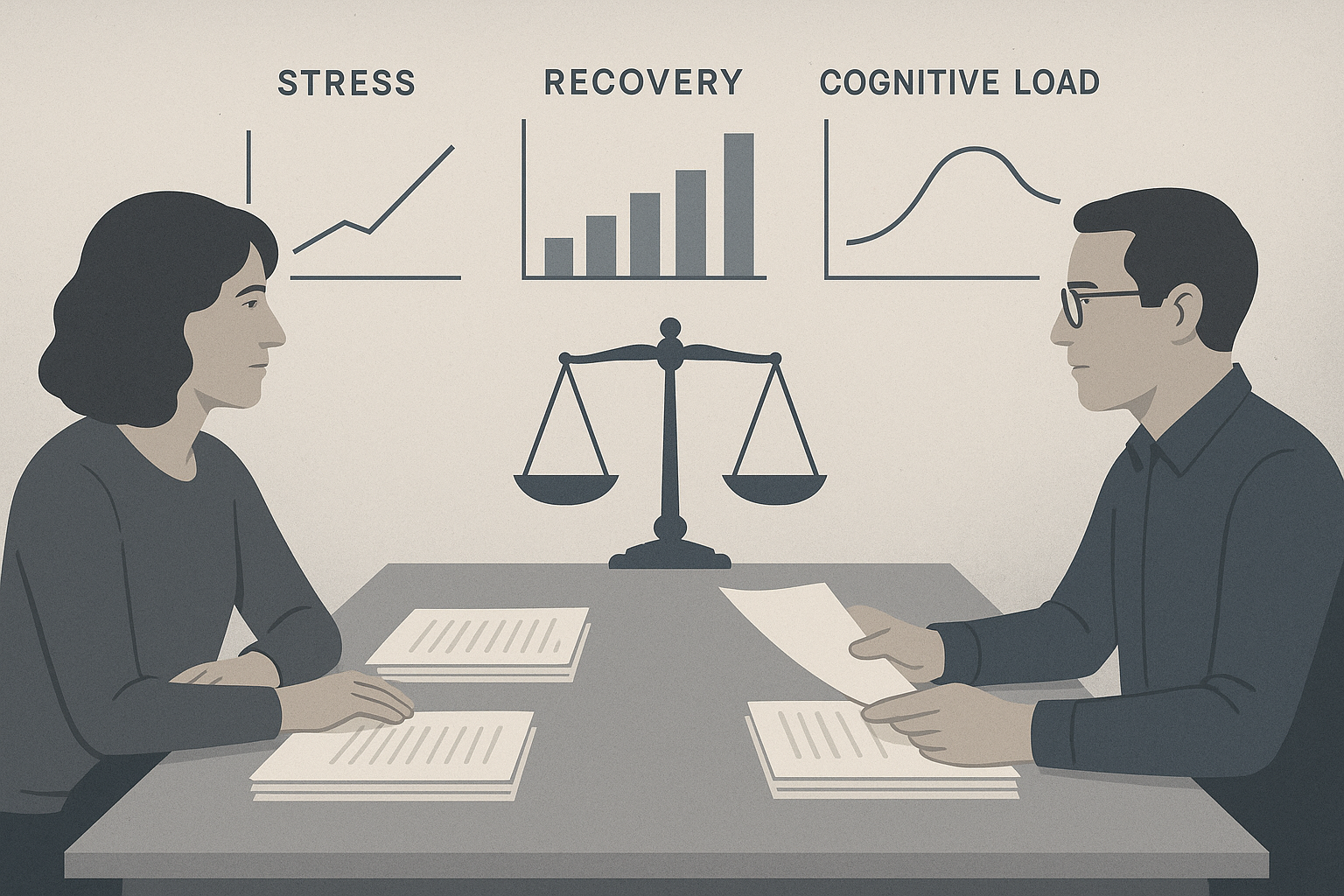
This test isn’t meant to entertain you or put you in a box. It’s designed to build an operational map of three dimensions that are often mistaken for one another:
- Stress load: how much pressure and activation you’re sustaining.
- Recovery debt: how much recovery you’re missing relative to what you’re expending.
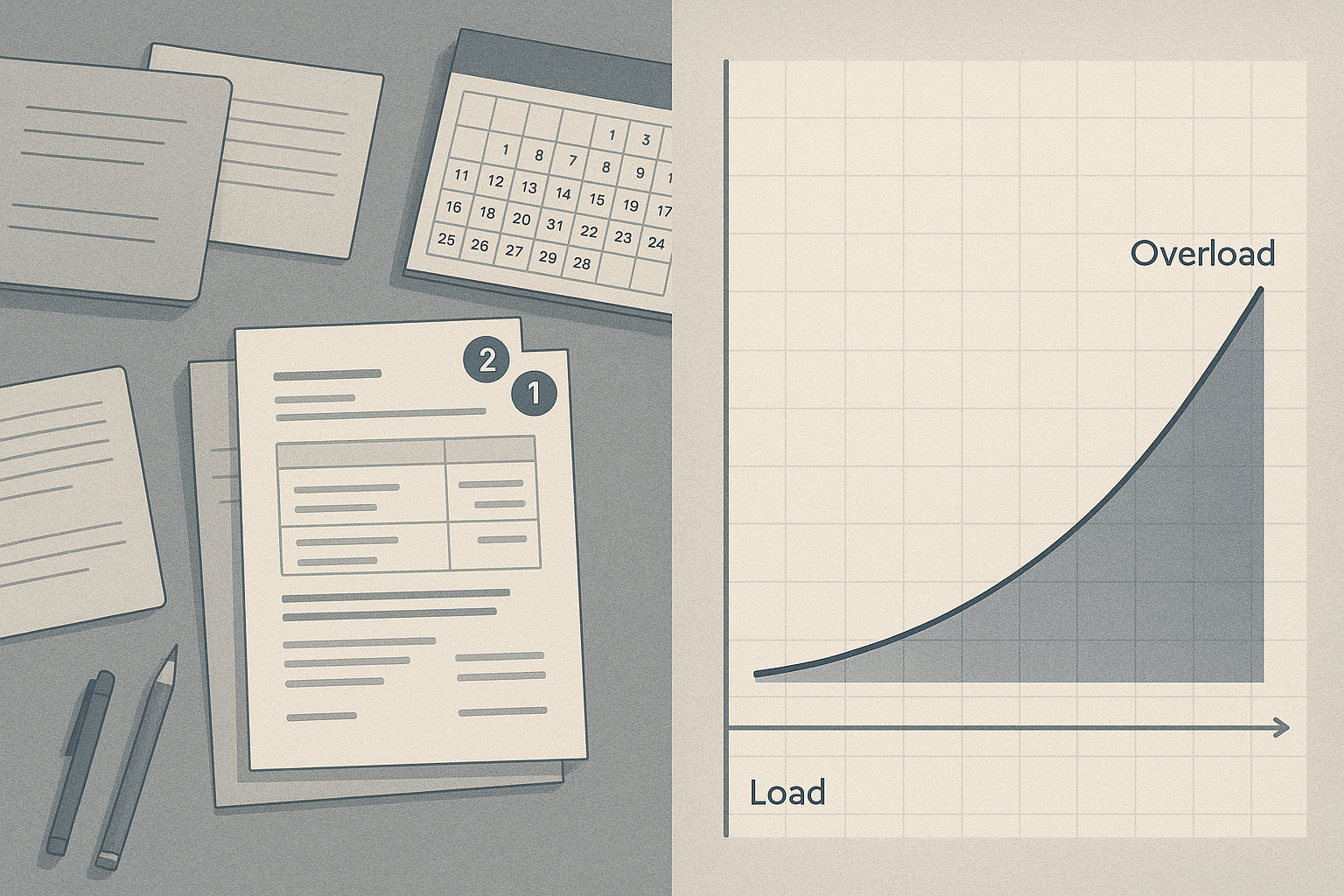
- Cognitive overload: how saturated your attentional/executive system is (interruptions, task switching, complexity, decision fatigue).
What it measures (and what it doesn’t)
What it measures
- Recurring patterns (not isolated episodes): signals that persist and reinforce themselves.
- Functional indicators: errors, recovery time, sleep quality, irritability, cognitive rigidity.
- Imbalances between demands and resources: when the way your day is structured “uses up” recovery.
What it does not measure
- A clinical diagnosis (e.g., anxiety disorders, depression, clinically defined burnout).
- “Fault” or “willpower”: here we analyze conditions and mechanisms, not personal virtues.
How to answer to get a useful result
- Time window: answer with the last 2–4 weeks in mind, not your worst day.
- Context: consider your real load (work + life), not just office hours.
- Precision: if you’re torn between two options, choose the one that describes what happens more often.
Interpretation: three axes, three different risks
Many people score high on one axis and low on another. That can completely change what you should prioritize.
1) High stress load (high-stress-load)
Indicates high exposure to demands, urgency, pressure, and conflicting priorities. The typical risk is hyperactivation: your body “keeps going,” but at the cost of irritability, tension, insomnia, or somatic symptoms.
2) High recovery debt (high-recovery-debt)
Indicates that recovery isn’t keeping pace with what you’re expending. The typical risk is chronicity: even if you reduce the load for a few days, you don’t truly get back to “zero.”
3) High cognitive overload (high-cognitive-overload)
Indicates saturation of working memory and executive control (interruptions, multitasking, constant decision-making). The typical risk is quality degradation: more time spent, less reliable output, more errors, and more rumination.
Signals not to ignore (not alarmism, but practical thresholds)
- Sleep: trouble falling asleep or frequent awakenings due to a “switched-on mind” ≥ 3 nights/week.
- Recovery: weekends that don’t restore energy or motivation.
- Attention: an increase in trivial mistakes, repeated rereading, difficulty starting simple tasks.
- Emotional regulation: disproportionate irritability, cynicism, reduced tolerance for minor demands.
- Body: jaw/neck tension, headaches, recurring gastrointestinal issues.
If these signals are intense, persistent, or accompanied by significant depressive symptoms, panic attacks, substance abuse, or thoughts of self-harm, it’s advisable to consult a healthcare professional.
What you’ll do after the test (guidance, not “recipes”)
Your results will help you choose one priority lever among three:
- Reduce the load (when the problem is exposure): negotiating scope, priorities, constraints, expectations.
- Increase recovery (when the problem is debt): sleep, decompression, boundaries, real micro-recovery breaks.
- Reduce cognitive overload (when the problem is saturation): protecting focus, batching, reducing task switching, interruption hygiene.
If you want to go deeper, you can compare these results with other Umanindex profiles: Stress & Recovery profile and Cognitive Focus profile.