Strategic Vision & Direction
Test: Ability to anticipate future scenarios
Assess how you anticipate future scenarios: the quality of the signals you pick up, the robustness of your hypotheses, how you manage uncertainty, and the impact of stress, recovery debt, and cognitive overload.
Why this test exists
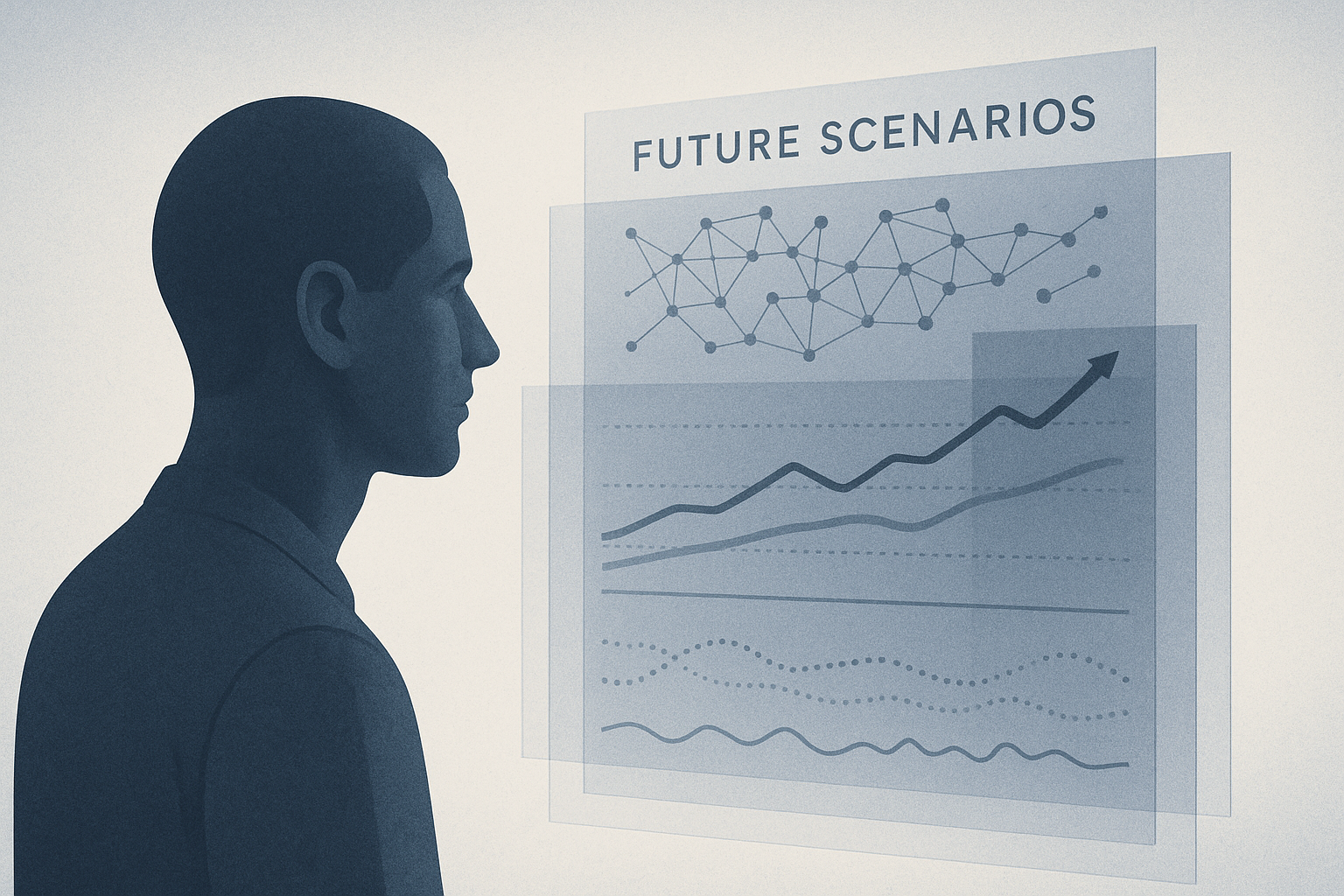
Anticipating future scenarios doesn’t mean “guessing” what will happen. It means building testable hypotheses about how context, constraints, and opportunities might evolve—while staying able to update your model as new data comes in.
This test measures three operational components:
- Detection: how well you pick up weak signals and regime shifts (not just obvious trends).
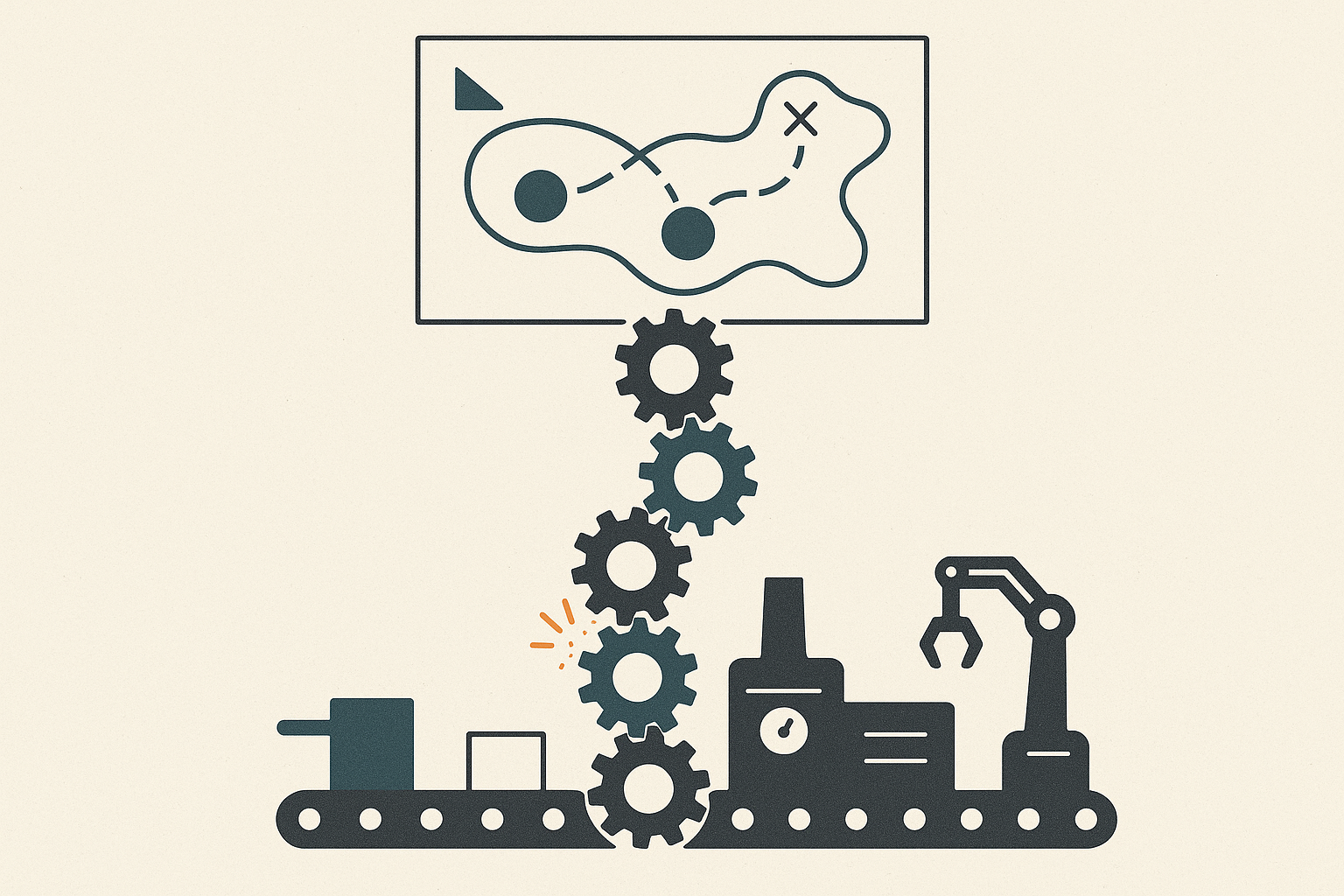
- Construction: how you turn signals into coherent scenarios (assumptions, drivers, alternatives, probabilities).
- Regulation: how you handle uncertainty and pressure without collapsing into oversimplification, anxiety, or over-analysis.
What we measure (and what we don’t)
We measure the quality of your process: selective attention, hypothesis discipline, ability to update, and mental load management. We do not measure general intelligence, cultural knowledge, or “innate talent.”
The result is most useful if you read it as a risk map: where your decision-making system tends to distort, speed up, or get stuck.
How to answer for a reliable profile
- Answer with the last 30–60 days in mind—not how you’d like to be.
- If you work in a team, assess your behavior when you’re the one leading the analysis or the decision.
- If a question feels like “it depends,” choose the option that describes what happens most often.
Interpretation: three physiological–cognitive axes that influence forecasting
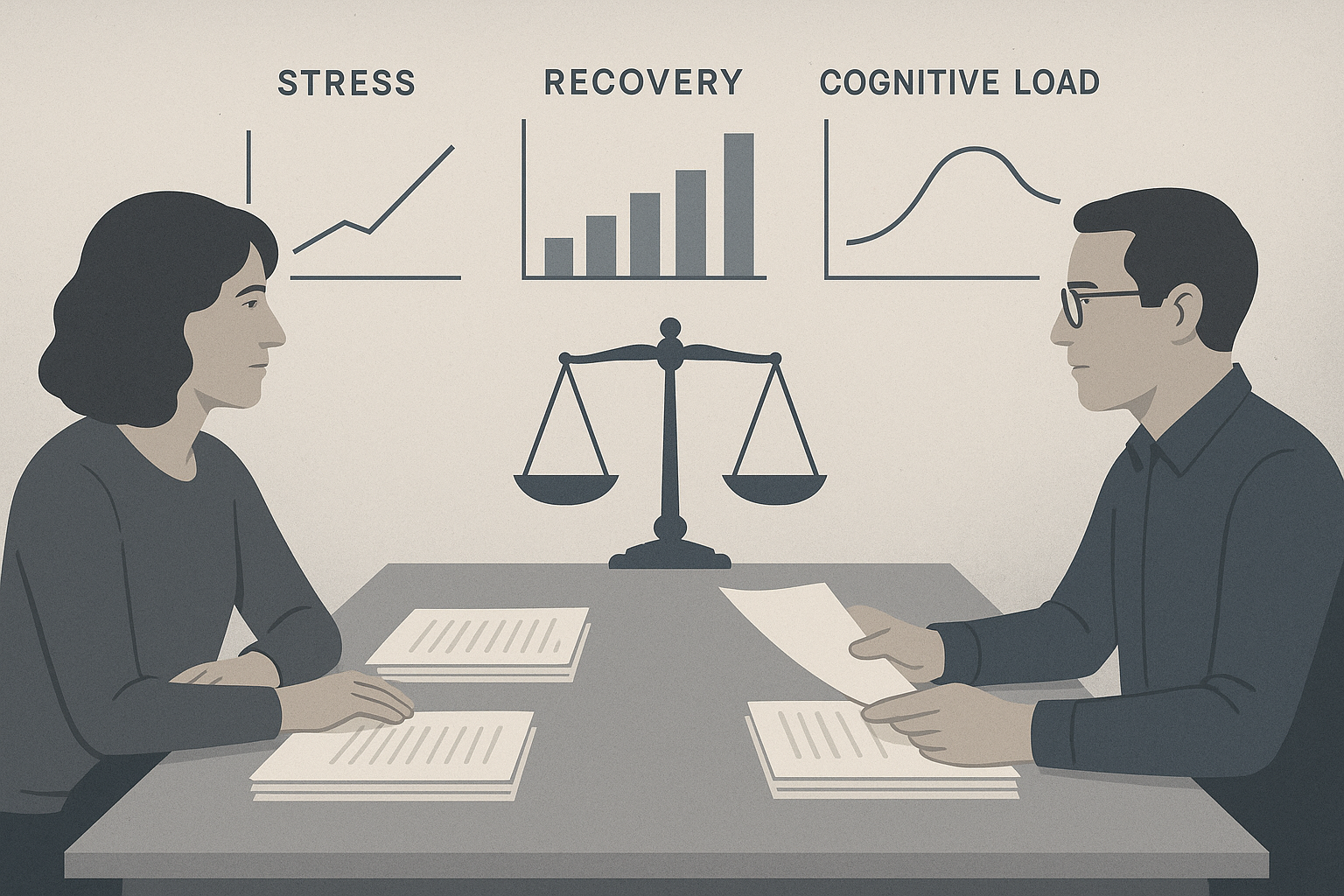
The ability to anticipate scenarios is sensitive to three cross-cutting variables. They aren’t “excuses”: they are internal contextual conditions that affect attention, working memory, tolerance for ambiguity, and the quality of hypothesis updating.
- Stress load: when high, it increases the drive for quick certainty and the selection of congruent information (confirmation bias).
- Recovery debt: insufficient sleep and recovery reduce cognitive flexibility and the ability to integrate weak signals.
- Cognitive overload: too many variables and unfiltered inputs lead to analysis paralysis or excessive shortcuts.
If you want to explore how Umanindex addresses these factors, you can consult: Stress Profile and Recovery Profile.
What you get at the end
- A concise profile of your prospective competence (detection, construction, regulation).
- Risk indicators for stress load, recovery debt, and cognitive overload that can undermine forecasting.
- An operational readout: where to intervene in the process (not “motivation”).
Methodological note (transparency)
The questions are phrased to reduce socially desirable responses and to distinguish between: (a) personal preferences, (b) procedural skills, and (c) load conditions. The test does not replace clinical or diagnostic assessments.
Frequently asked questions
Is anticipating future scenarios the same as making forecasts?
No. Forecasting aims at a specific outcome (“X will happen”). Anticipation builds a set of plausible scenarios, makes assumptions and signals explicit, and defines how to update the model when data changes.
How much does experience affect the outcome?
It matters, but it’s not decisive. Experience improves pattern recognition, but it can also harden assumptions. The test mainly evaluates process discipline: how you filter signals, how you handle alternatives, and how you update your beliefs.
Why do you include stress, recovery, and cognitive overload in a strategic vision test?
Because they directly affect attention, working memory, and cognitive flexibility. Under high stress or insufficient recovery, decision shortcuts, certainty-seeking, and reduced ability to integrate weak signals increase.
If I get a low score, does it mean I’m not suited for strategy?
Not necessarily. A low score may indicate an unstructured process, a high-load context, or a tendency to close off hypotheses too early. The value of the result is identifying where your system becomes unbalanced and under which conditions.
How reliable is a self-assessment test on such a complex topic?
It’s reliable for identifying recurring patterns (e.g., rigid assumptions, too much input, difficulty updating) if you answer based on recent, concrete behaviors. It doesn’t replace field observations or performance metrics, but it helps guide targeted process interventions.
What’s the difference between “cognitive overload” and “stress”?
Stress concerns arousal and perceived pressure (urgency, threat, responsibility). Cognitive overload concerns the amount/complexity of information and simultaneous decisions relative to your processing capacity. They can coexist, but they require different strategies.
How long does it take, and how should I prepare?
On average 8–12 minutes. No preparation is needed: it’s better to answer without “constructing” an ideal image of yourself. If possible, avoid doing it at a time of constant interruptions.
Can I use the result to improve decision-making and planning in my team?
Yes, if you use it as a basis for method agreements: which signals to monitor, how to document assumptions, when to review scenarios, and how to manage information load. The test is most useful when it leads to changes in the process, not just a description.