Engagement & Motivation

Energy and work participation: a map of load, recovery, and cognitive overload

16 questions 8 min44 people have taken this test
Energy and work participation: a map of load, recovery, and cognitive overload

Assess hidden patterns that influence energy and participation at work: stress load, recovery debt, and cognitive overload. Results designed to support awareness and autonomy.

Sign up or log in to take the test

Registration is required to start any test.

What this test analyzes

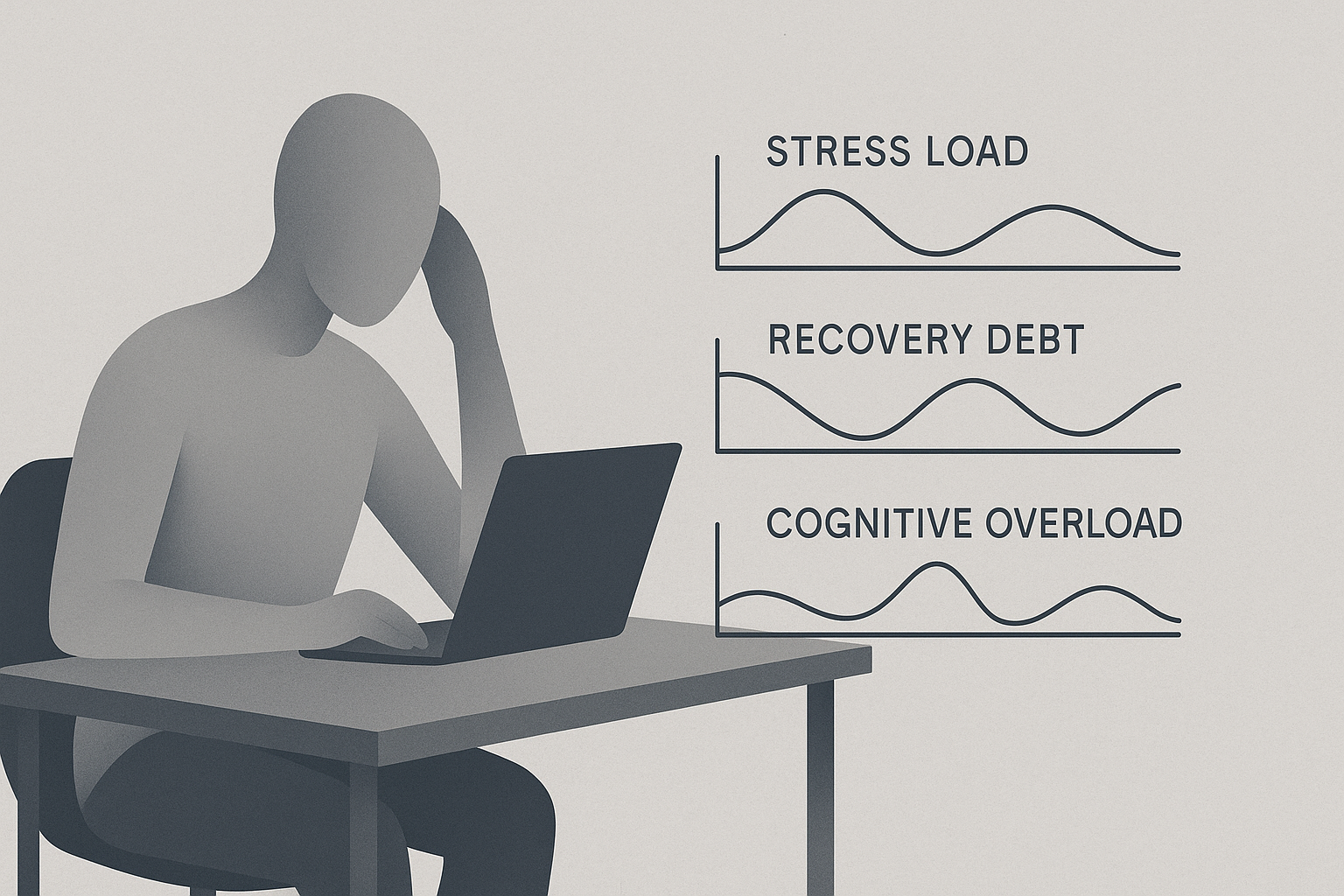
Intensity and continuity of demands (urgency, pressure, conflicts, vigilance). High values indicate sustained activation and limited flexibility in adjusting the workload.
Gap between effort and recovery (sleep, decompression, real breaks, mentally switching off). High values indicate insufficient or ineffective recovery.
Saturation of attentional and executive resources (interruptions, fragmentation, ambiguity, too many decisions). High values indicate that available mental bandwidth is insufficient relative to current demands.

Why this test exists (and what it isn’t)

This test is designed to measure how you’re sustaining engagement at work—not how “motivated” you are. For many people, work energy doesn’t drop because of a lack of willpower, but because of a combination of stress load, recovery debt, and cognitive overload. These three factors can produce the same end symptoms (disengagement, irritability, procrastination, cynicism), but they call for different interpretations.

You won’t find motivational slogans or generic advice here. Instead, you’ll find a set of questions designed to surface recurring patterns and psychophysiological imbalances that often remain invisible until they become a problem.

What we measure: three axes that are often confused

1) Stress load (axis_stress_load)

This refers to the intensity and frequency of the demands your system has to manage: urgency, conflict, ambiguity, performance pressure, interruptions, emotional responsibilities. A high load isn’t “always negative,” but it becomes risky when it’s continuous or not adjustable.

2) Recovery debt (axis_recovery_debt)

This refers to the gap between what you expend and what you restore. It’s not the same as “not sleeping enough”: it includes sleep quality, mental decompression, real breaks, physical recovery, and the ability to switch off. Recovery debt can keep activation high even when external demands decrease.

3) Cognitive overload (axis_cognitive_overload)

This refers to the saturation of attentional and executive resources: too many decisions, too many open tabs, constantly shifting contexts, unstructured information, implicit expectations. It’s an often underestimated axis: you can have “time” and still not have mental bandwidth.

How to answer to get a useful profile

  • Time window: answer with the last two weeks in mind, not an exceptional day.
  • Context: consider your actual work (constraints, tools, people), not the ideal version.
  • Functional honesty: don’t answer how you “should” be. Answer how it plays out when no one is watching.
  • If you’re unsure: choose the option that describes what happens most often.

How to read the results (interpretive logic)

The test returns a profile across three axes. Some common combinations:

  • High stress load + High recovery debt: risk of “forced endurance”: you keep functioning, but at increasing cost (irritability, reduced empathy, avoidable mistakes).
  • Medium stress load + High cognitive overload: you’re not necessarily “under pressure,” but you’re mentally over-occupied: fragmentation, difficulty getting started, a sense of confusion.
  • High stress load + High cognitive overload: a high-demand, low-control environment: reactivity, over-control, or avoidance often emerges.
  • High recovery debt with the others at medium: the main issue may be a lack of restoration: even normal tasks start to feel heavy.

If you want to explore the recovery dimension further, you can also use this internal placeholder: a deep dive into psychophysiological recovery.

Responsibility note

This tool is for self-reflection and does not replace a clinical assessment. If you’re experiencing intense or persistent symptoms (severe insomnia, panic attacks, thoughts of self-harm, substance use to cope), it’s advisable to speak with a healthcare professional.


Frequently asked questions

Does this test measure motivation or energy?
It mainly measures the conditions that make it possible (or difficult) to sustain energy and participation: stress load, recovery debt, and cognitive overload. Motivation may be present but “not accessible” when one of these axes is out of balance.
How reliable is a self-assessment test?
It’s reliable for surfacing recurring patterns if you answer with a defined time window in mind (here: the last 2 weeks) and if you don’t use a single episode as your reference point. It’s not a diagnosis: it’s a decision map to understand where to intervene more precisely.
Why distinguish stress load and cognitive overload? Aren’t they the same thing?
No. Stress load is mainly about intensity/urgency and emotional or relational pressure; cognitive overload is about attentional saturation, too many decisions, and fragmentation. You can have cognitive overload even without urgency—for example, with messy information flows.
If my recovery debt is high, does that mean I just need to sleep more?
Not necessarily. Recovery debt includes sleep quality, ability to decompress, real breaks, physical recovery, and mental “switching off.” Sometimes the issue is evening hyperarousal or the lack of micro-recovery during the day, not just the number of hours.
What does it mean to have low engagement but not very high stress?
It may indicate cognitive overload (too much in your head, not enough clarity), or a disconnect between goals and the meaning of the work, or a recovery debt that makes everything more effortful. The three-axis profile is meant precisely to avoid simplistic interpretations.
Can I use the results to talk with my manager or HR?
Yes, if you use them to describe operating conditions (interruptions, ambiguity, decision load, recovery time) and not as personal labels. It’s often more effective to discuss adjustable levers (priorities, workflows, boundaries, tools) than “motivation.”
How often does it make sense to repeat the test?
Generally every 3–6 weeks, or after significant changes (new project, team change, seasonal peaks). Repeating it too often increases noise: the goal is to observe trends, not day-to-day fluctuations.
If high scores emerge on all three axes, what should I infer?
That you’re probably sustaining participation at a high cost. In these cases it helps to distinguish what can be changed immediately (reducing interruptions, clarifying priorities, deep-work blocks, micro-recovery) from what requires structural interventions (workloads, roles, boundaries, support).

Recommended tests

All tests