
Engagement & Motivation

Corporate Values Alignment Test

14 questions 8 min89 people have taken this test
Corporate Values Alignment Test

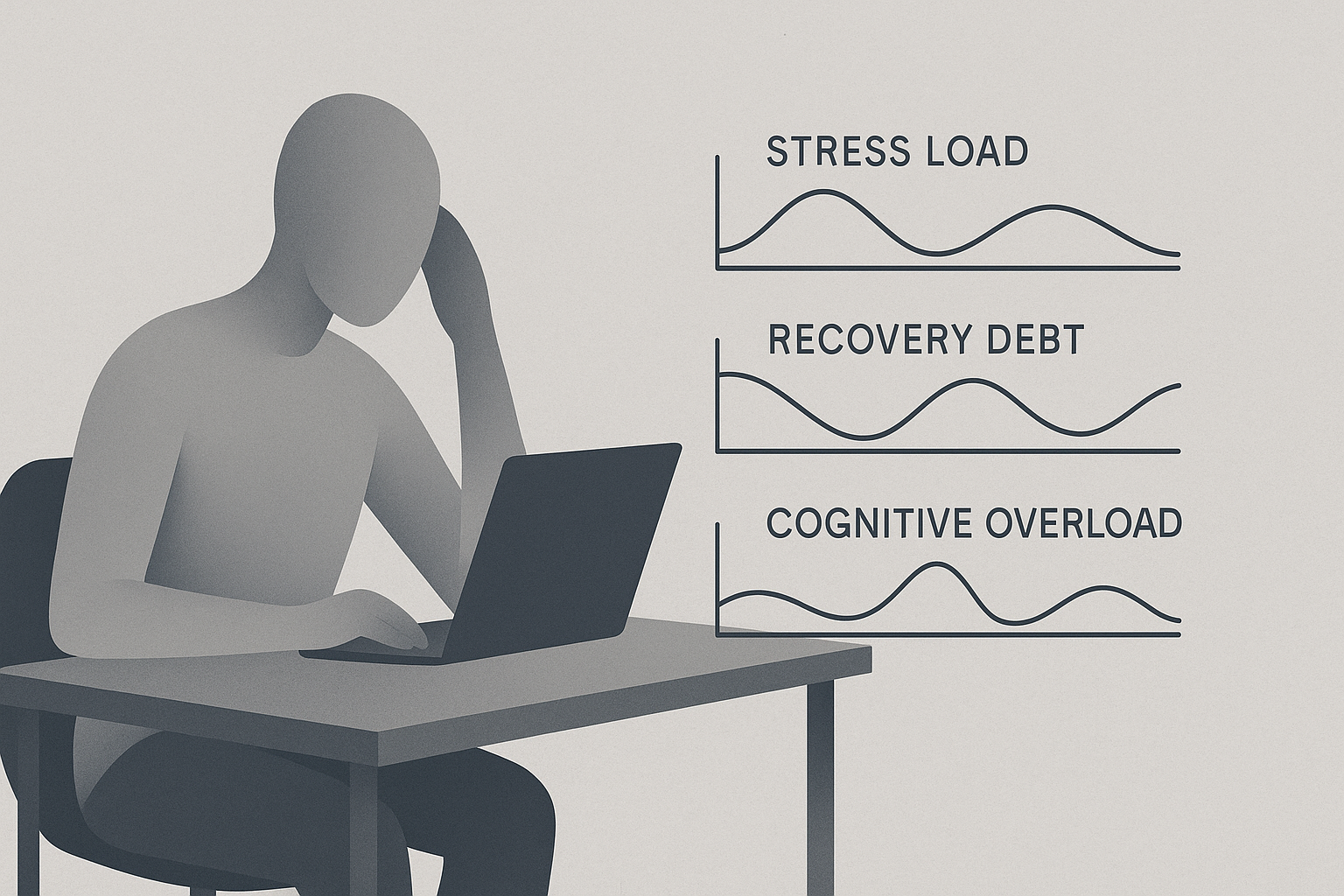
Assess how consistent your day-to-day behaviors are with the company’s stated values. Identify signs of misalignment, stress load, recovery debt, and cognitive overload.

Sign up or log in to take the test

Registration is required to start any test.

What this test analyzes

Stress load
Index of perceived pressure and sustained alertness associated with urgent demands, social risk, conflicts, and operational inconsistencies.
Recovery debt
Index of the gap between the recovery you need and the recovery you actually get: sleep, mental decompression, and your ability to bounce back after demanding days.
Cognitive overload
An index measuring how much mental energy is spent managing ambiguity, fragmentation, contradictory signals, and social monitoring.

Why this test exists (and what it really measures)

“Alignment with corporate values” is often treated as an internal communications topic. In reality, it is a psychophysiological and decision-making phenomenon: when what you do every day is consistent with what the organization says it values, your brain spends less energy on monitoring, rationalizing, and managing social risk. When there is misalignment, stress, recovery fatigue, and cognitive load increase, with measurable effects on attention, motivation, and decision quality.

This test doesn’t assess “how motivated you are” in the abstract. It assesses how much your work environment requires you to operate against (or beyond) your standards for integrity, clarity, and priorities.

What you’ll get at the end

  • Hidden patterns: where friction is created between stated values and actual practices.
  • Imbalance indicators: signals consistent with chronic stress, recovery debt, and cognitive overload.
  • Levers of autonomy: areas you can act on with concrete, verifiable steps (not “motivational advice”).

How to answer (to improve accuracy)

  1. Answer with the last 4 weeks in mind, not exceptional periods.
  2. If you have different roles (projects/manager/client), focus on the one that consumes the most energy.
  3. If you’re torn between two options, choose the one that describes what happens most often, not what “should” happen.

What we mean by “values” (operational definition)

In this test, values aren’t slogans. They are decision criteria that should be observable in:

  • priorities (what gets protected under pressure),
  • trade-offs (what gets sacrificed, and how it’s justified),
  • repeated behaviors (not exceptions),
  • consequences (who gets rewarded, who gets penalized).

Three axes we’ll use to interpret the results

1) Stress load (stress-load-axis)

How often your system is in “alert” mode: urgency, ambiguity, social pressure, reputational risk, unresolved conflicts.

2) Recovery debt (recovery-debt-axis)

How much recovery you’re missing: non-restorative sleep, difficulty “switching off,” irritability, reduced initiative. It’s not laziness—it’s an indicator of depleted physiological resources.

3) Cognitive overload (cognitive-overload-axis)

How much mental energy you spend interpreting contradictory signals, avoiding social missteps, managing exceptions, and switching contexts. Overload reduces judgment quality and increases emotional friction.

When this test is especially useful

  • You have a good role/pay but feel “worn down” by dynamics you can’t quite name.
  • You notice growing cynicism or emotional detachment from work.
  • You realize that, to “function,” you have to normalize practices you don’t agree with.
  • You’re considering changing teams/companies and want criteria more solid than “I like it/I don’t like it.”

Responsibility note

This tool is for self-analysis and does not replace clinical or medical evaluation. If you recognize intense and persistent signs (severe insomnia, constant anxiety, significant somatic symptoms), consider speaking with a qualified professional.

Related deep dives (optional)

Frequently asked questions

What’s the difference between “declared values” and “practiced values”?
Declared values are what the organization communicates (mission, posters, onboarding). Practiced values are what emerges from repeated behaviors: what gets rewarded, what gets tolerated, what gets punished. Misalignment between the two is a typical source of stress and cognitive overload.
Is it possible to be aligned with company values and still be stressed?
Yes. Alignment reduces a portion of stress linked to ethical conflict and ambiguity, but it doesn’t eliminate stress from workload, deadlines, technical complexity, or personal factors. That’s why the test separates stress load, recovery debt, and cognitive overload.
What does “recovery debt” mean in concrete terms?
It’s the gap between recovery needed and recovery actually achieved. It shows up as unrefreshing sleep, difficulty switching off, reduced patience, decreased mental flexibility, and an increasing need for stimulation (caffeine, scrolling) to maintain performance.
If the result indicates misalignment, do I need to change jobs?
Not necessarily. The value of the result is identifying where the friction comes from: unclear priorities, managerial inconsistency, distorted incentives, lack of psychological safety. In some cases you can intervene with clarification, boundaries, and negotiation; in others the cost of adapting remains structural.
How reliable are the answers if I fear consequences or judgment?
The test is designed for self-analysis: accuracy depends on your ability to answer based on observable behaviors (frequency, examples) rather than intentions. If you feel fear or hyper-control even just while answering, that’s already a useful signal of stress load and perceived social risk.
What signs indicate that cognitive overload is becoming a problem?
Simple mistakes, difficulty prioritizing, “smart” procrastination (you delay because everything feels risky), irritability when new requests come in, needing to reread multiple times, a sense of confusion even with familiar tasks. It often coexists with recovery debt.
Does this test also measure engagement?
It infers it indirectly: sustainable engagement tends to coexist with value coherence, clear priorities, and adequate recovery. If energy is high but recovery is low, it may be compensatory drive (over-adaptation) rather than stable engagement.

Recommended tests

All tests