Communication & Collaboration
Test: difficulties in teamwork (patterns, stress, and cognitive overload)
Assess the root causes of difficulties in teamwork: stress load, recovery debt, and cognitive overload. Results geared toward awareness and autonomy.
Why take a test on teamwork difficulties
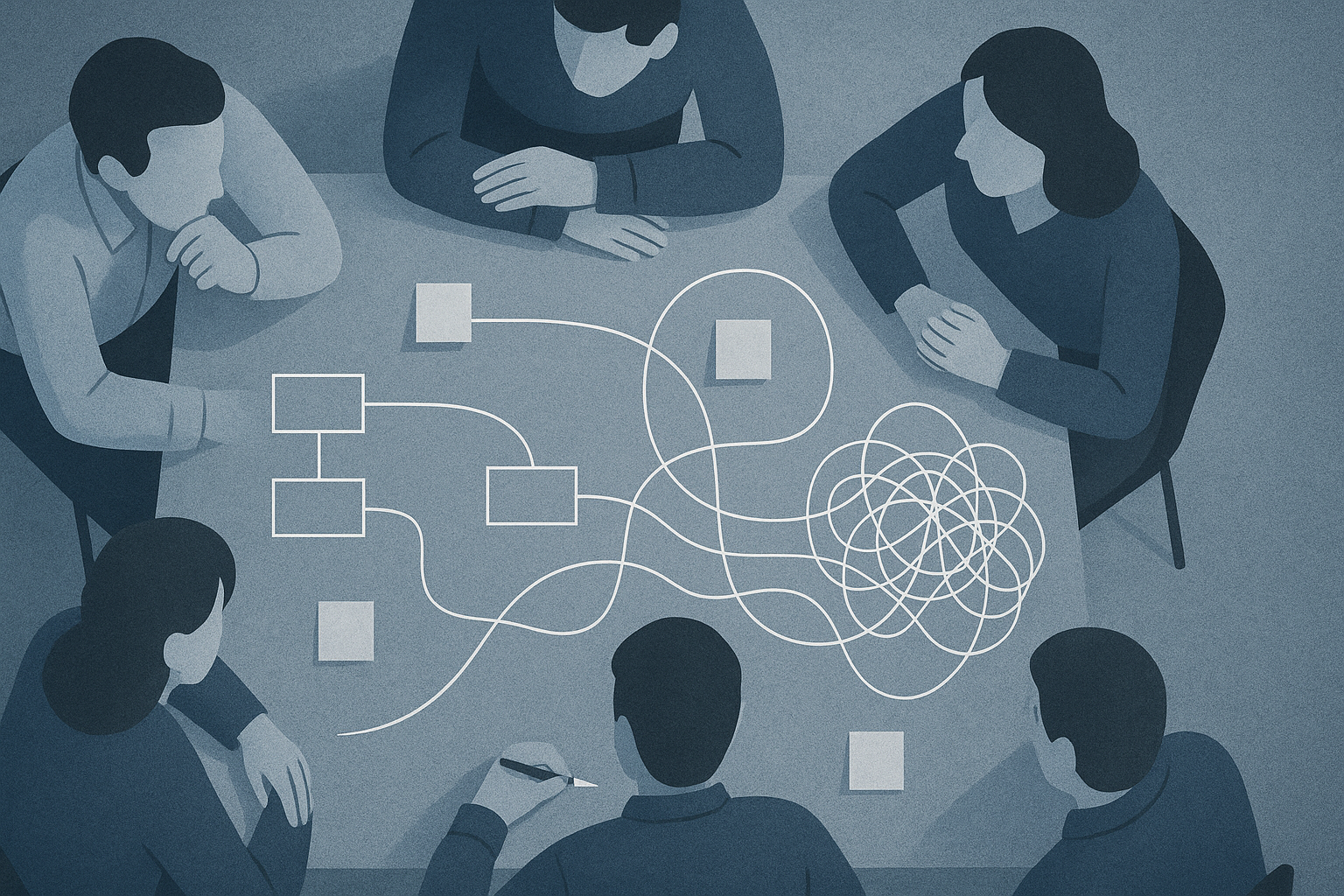
Difficulties in teamwork rarely depend solely on “personality” or a “lack of soft skills.” More often, they arise from the interaction between stress load, recovery debt, and cognitive overload, which affect attention, emotional regulation, working memory, and the ability to coordinate.
This test is not meant to label people or offer generic advice. Its purpose is to identify recurring patterns that make collaboration fragile: how decision-making deteriorates under pressure, when communication becomes defensive, and which physiological and organizational conditions amplify friction and misunderstandings.
What it measures (and what it does not)
It measures
- Stress Load axis: the intensity and persistence of perceived demands (urgency, conflict, ambiguity, social pressure).
- Recovery Debt axis: the extent to which recovery (sleep, breaks, decompression) is insufficient relative to the load.
- Cognitive Overload axis: saturation of working memory and attention (too many variables, interruptions, multitasking, an unstable context).
It does not measure
- Technical competence or “objective” performance.
- Clinical diagnoses (anxiety, depression, ADHD, burnout). If you suspect a clinical issue, this test can be a signal—not a conclusion.
- Who is “right” in conflicts: it assesses conditions and dynamics, not blame.
How to interpret the results
Team difficulties can look the same on the surface (irritability, rigidity, avoidance, hyper-control) but have different roots:
- High Stress Load: greater reactivity, sharper communication, reduced listening, increased defensiveness and attribution (“they don’t get it,” “they’re not committed”).
- High Recovery Debt: low frustration tolerance, reduced patience, misinterpretations, difficulty “repairing” after friction.
- High Cognitive Overload: confusion about priorities and responsibilities, meetings that don’t converge, decisions that get reopened, long or ambiguous messages, loss of context.
The value of the test is in distinguishing the social symptom (e.g., “they don’t collaborate”) from the system condition (e.g., overload + insufficient recovery) that makes it likely.
Quick instructions
- Answer with the last 3–4 weeks in mind, not a single episode.
- If you work across multiple teams, think about the one where you feel the most friction.
- Choose the option closest to your actual frequency, even if you don’t like it.
Who it’s useful for
- Professionals who experience recurring friction (tense meetings, unstable decisions, passive-aggressive exchanges).
- Team leaders who want to understand whether the problem is relational, organizational, or physiological (or a combination).
- People who recognize patterns of hyper-control, avoidance, or “I collaborate, but it drains me.”
Related deep dives
If you want to explore specific aspects, you can also use:
Frequently asked questions
Does this test assess “compatibility” with the team?
No. It assesses conditions and patterns that make collaboration more fragile (stress, insufficient recovery, overload). “Compatibility” is too broad a concept and often conflates personal preferences with contextual constraints.
If I get high scores, does that mean I’m the problem?
Not necessarily. High scores indicate that, in recent weeks, your system (attention, emotional regulation, energy) has been operating near its limit. Under these conditions, misunderstandings and communication rigidity increase, even in highly competent people.
What’s the difference between Stress Load and Cognitive Overload?
Stress Load concerns perceived pressure (urgency, conflict, risk, social evaluation). Cognitive Overload concerns the saturation of your capacity to handle information and decisions (too many variables, interruptions, unstable context). They can coexist, but they are not the same thing.
Is recovery debt just about sleep?
Sleep is central, but it’s not enough. Recovery debt also includes insufficient breaks, lack of mental decompression, unprocessed emotional load, and continuous stimulation (notifications, always-on availability) that prevents the system from “downshifting.”
Why do some people become more aggressive or quieter under pressure?
They are two different protective strategies. With high stress and low recovery, the system tends to reduce complexity: some people react with control and confrontation (to restore predictability), others with withdrawal and avoidance (to reduce stimuli and risk).
How reliable is a self-assessment test on these topics?
It’s useful for identifying recurring patterns and actionable hypotheses, but it remains a subjective measure. Accuracy improves if you answer with a defined time window (3–4 weeks) and compare results with observable signals: sleep quality, mistakes, conflicts, decision time, task churn.
What can I do if the test indicates high overload but I can’t reduce the workload?
The point isn’t to “do less” in the abstract, but to reduce variability and coordination costs: clarify decision criteria, reduce parallel channels, limit interruptions, make priorities and definitions of done explicit. Even small process constraints can free up working memory.
Can this test replace a conversation with HR, a manager, or a professional?
No. It can help you prepare a more precise conversation: instead of speaking in vague terms (“the team isn’t working”), you can bring observations about load, recovery, interruptions, decision ambiguity, and moments when communication deteriorates.