Why a test on “eating under stress” (without oversimplifying)
When stress rises, eating habits rarely change “just” because of a lack of willpower. More often, the whole regulation system shifts: internal signals (hunger/satiety), cognitive priorities, recovery quality, and the amount of mental energy available. This test isn’t meant to label you, but to make visible patterns that usually stay implicit.
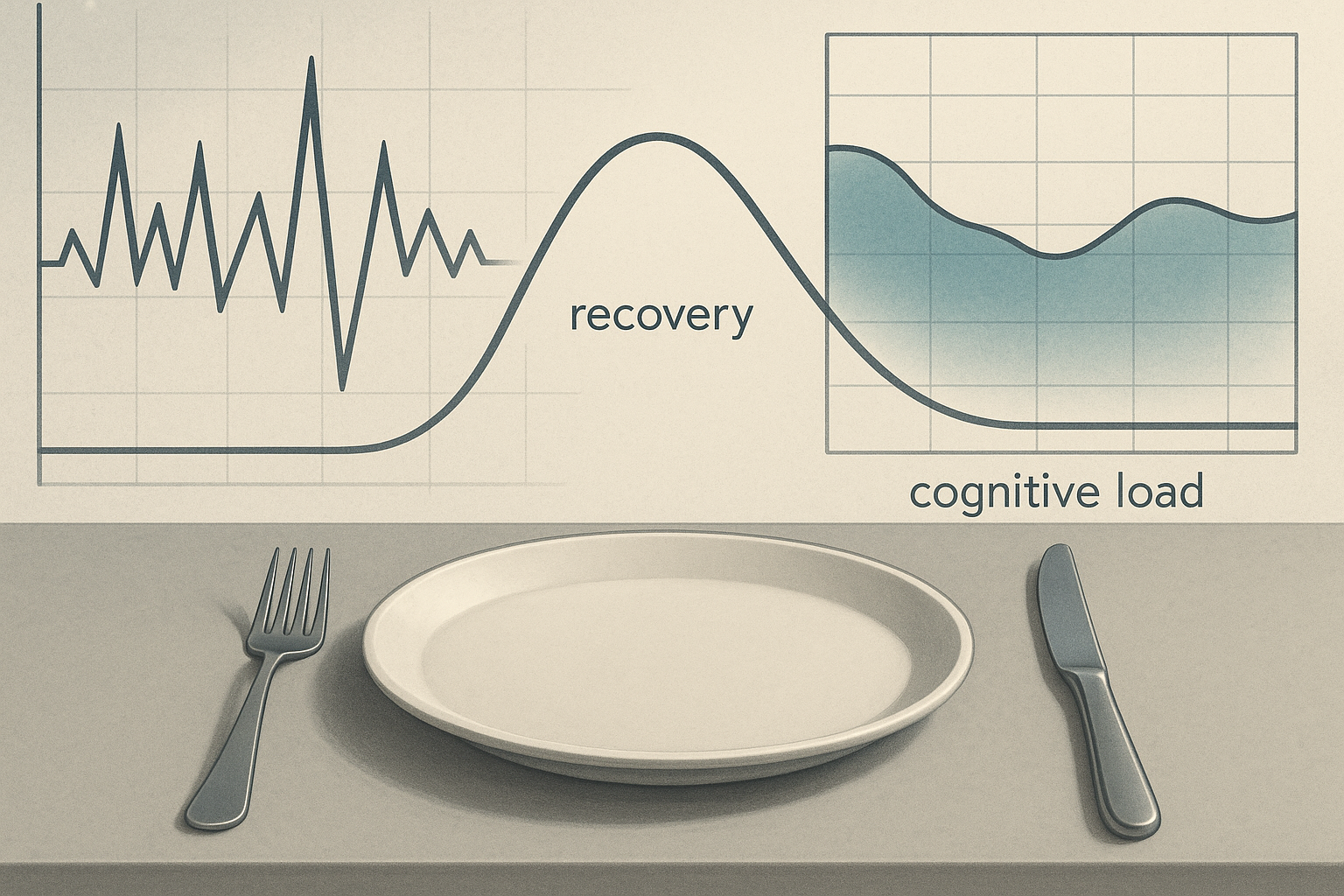
You’ll assess three complementary axes:
- Stress load: how much pressure your system is under (time constraints, demands, perceived threats).
- Recovery debt: how much sleep, breaks, and decompression are failing to offset the load.
- Cognitive overload: how much “mental bandwidth” is taken up, reducing your ability to choose and plan.
What this test actually assesses
The questions are designed to distinguish between phenomena that are often conflated:
- Physiological hunger vs. urgency: the former builds gradually and is satisfied by a meal; the latter is sudden, specific, and often linked to tension or fatigue.
- Stimulus seeking: craving saltier/sweeter/fattier foods as a quick way to modulate arousal (not a “vice,” but a short-term strategy).
- Decision fatigue: when too many decisions reduce the quality of later choices, especially in the evening.
- Rhythms and recovery: fragmented sleep, skipped breaks, and evening work can alter appetite, impulses, and frustration tolerance.
How to answer (to get a useful profile)
- Answer with the last 2 weeks in mind, not “how you’d like to be.”
- If your days vary a lot, base your answers on the most common situation.
- Don’t aim for consistency: the value is in the contradictions (e.g., “I eat little” but “I snack often”).
Note: this test is not a diagnostic tool. If you suspect an eating disorder or a medical condition, use the results as a starting point to discuss it with a professional.
How to read the results: three axes, three different levers
1) Stress load (stress-load-axis)
A high score indicates that your system is often in “rapid response” mode: prioritizing urgent demands, reduced sensitivity to subtle signals (satiety, fatigue), and a greater tendency toward immediate choices.
2) Recovery debt (recovery-debt-axis)
A high score suggests that stress isn’t being offset. In this state, food can become a form of substitute recovery (comfort, sedation, stimulation), especially when sleep and real breaks are missing.
3) Cognitive overload (cognitive-overload-axis)
A high score signals that your capacity to plan and choose is saturated. It’s not “poor discipline”: it’s low executive availability. Typically, it increases: automatic snacking, delayed food decisions, disorganized meals, and greater reactivity to environmental triggers.
Typical patterns this test can reveal
- High stress + low recovery: risk of oscillations (daytime restriction → evening compensation), “late” hunger, irritability, and seeking energy-dense foods.
- High cognitive overload with moderate stress: not necessarily high anxiety, but too many micro-decisions; the issue is managing the context (availability, routine, friction).
- High stress with decent recovery: good resilience, but possible situational episodes (meetings, deadlines) where eating becomes a tool for rapid regulation.
Further reading (if you want to work on the system, not the symptom)
If the results point to high load and overload, it’s often more effective to intervene on: rhythms (sleep/breaks), choice architecture (what’s available when you’re tired), and early signals (tension, attention dips, irritability) before they turn into urgent hunger.
You can also compare this profile with other internal tests to understand whether the main driver is physiological (recovery) or cognitive (overload): {{internal_link_1}} and {{internal_link_2}}.