Nutrition & Mindful Eating Awareness
Mindful Eating Awareness Test: recognize automatic habits, bodily signals, and cognitive load
Assess your mindful eating awareness: hunger/satiety cues, automatic habits, stress, and recovery. Identify hidden patterns and areas of imbalance with a structured test.
Why this test exists (and what it actually measures)
Low mindful eating awareness rarely comes down to a “lack of willpower.” More often, it’s the combined effect of three measurable factors:
- Stress load (how much pressure your system is under, and how often it switches into “urgency” mode);
- Recovery debt (sleep, breaks, decompression: how much you truly recover compared to how much you expend);
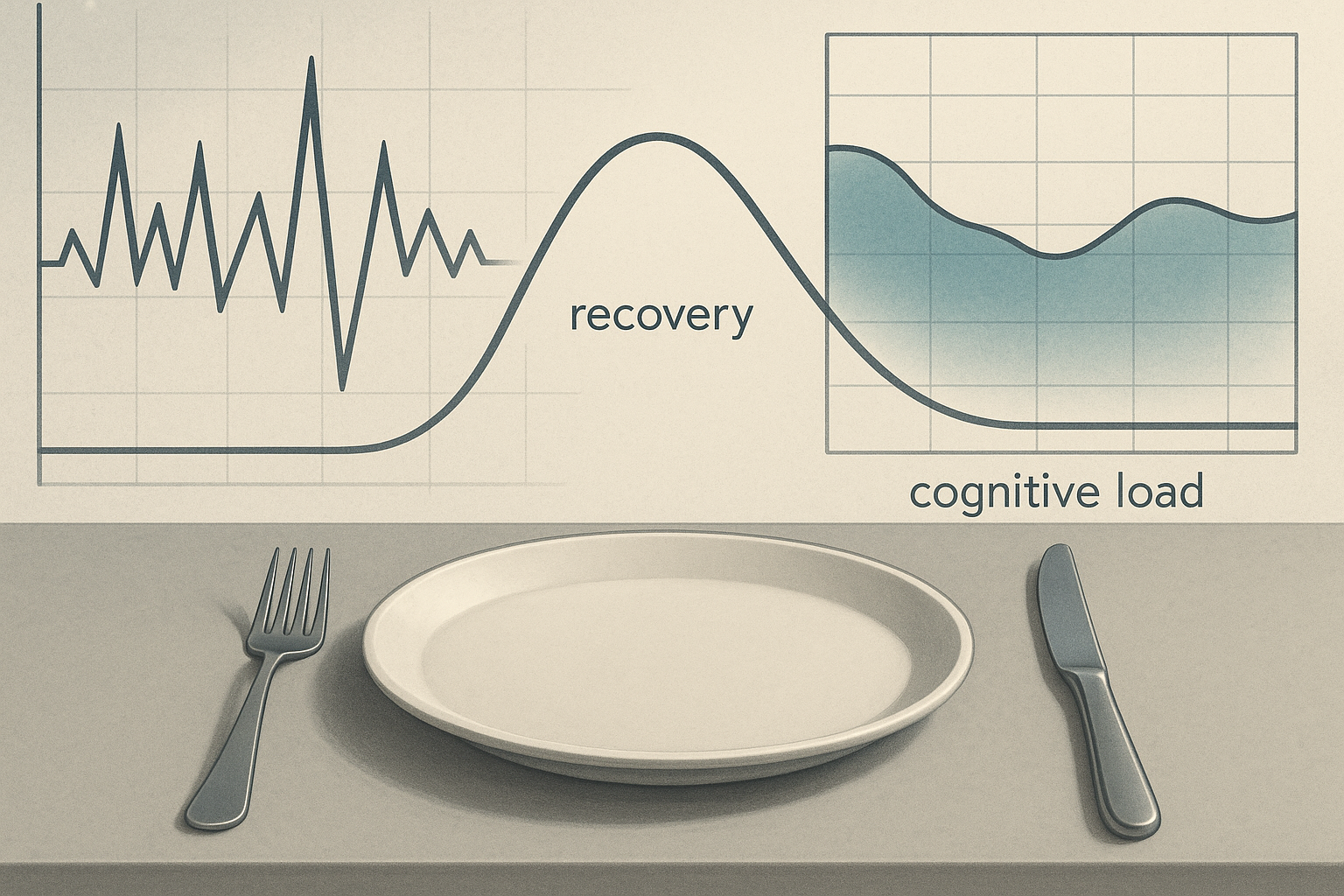
- Cognitive overload (how much mental energy is taken up by decisions, multitasking, and information noise).
When these three axes rise, the likelihood increases of:
- eating automatically (without noticing quantity, taste, or satiety);
- confusing physiological hunger with emotional activation or fatigue;
- seeking “high reward-density” foods (sweet/salty/fatty) for quick regulation;
- oscillating between rigid control and loss of control.
How to interpret the result
The test doesn’t label anything as “right” or “wrong.” It produces a profile across three axes:
- axis_stress_load: the intensity and frequency of stress activation that interferes with choices and bodily signals.
- axis_recovery_debt: the gap between energy expenditure (physical/mental) and real recovery (sleep, breaks, decompression).
- axis_cognitive_overload: the saturation of attention and working memory that leads to impulsive decisions or defaulting to habit.
Methodological note: the questions are designed to capture patterns (repetition) rather than isolated episodes. Answer with the last 2–3 weeks in mind.
Typical signs of low mindful eating awareness (non-pathologizing)
- Food amnesia: you struggle to remember what you ate or how much.
- “Delayed” satiety: you realize you’re full only after you’ve already gone past the point.
- Hunger that changes shape: it’s less hunger and more restlessness, emptiness, urgency, a need for “something.”
- Decision fatigue: at the end of the day, you choose on autopilot (delivery, snacks, large portions).
- Compensation: you alternate between restriction and an impulsive calorie rebound.
Before you start: quick instructions
- Answer descriptively, not aspirationally.
- If you’re torn between two options, choose the more frequent one.
- Consider your context: work, study, shifts, family, training, health.
If you want to go deeper after the test: guide to mindful eating awareness and stress, hunger, and regulation.
What you can get from this test
A good result isn’t “eating perfectly.” It is:
- recognizing when you’re eating in response to a physiological cue vs. emotional regulation;
- understanding which conditions (sleep, stress, multitasking) push you toward automatic habits;
- identifying a realistic leverage point (recovery, structure, environment, attention) instead of adding more rules.
Frequently asked questions
Does this test assess diet quality (macros, calories, “healthy/unhealthy”)?
No. It mainly assesses processes: hunger/satiety perception, habits/automaticity, the decision-making context, and the impact of stress and recovery. Nutritional quality can be excellent while awareness is low (or vice versa).
How do you distinguish physiological hunger from emotional hunger?
Not with a single question. We use converging indicators: speed of onset, urgency, specificity of the food craved, the link with stress/fatigue, and the presence of bodily signals (stomach emptiness, low energy, fasting-related irritability).
If I score high on stress load, does it mean I have a clinical problem?
No. A high score indicates that stress is measurably interfering with attention and eating self-regulation. It is not a diagnosis. However, if stress is persistent and affects sleep, mood, or daily functioning, a professional consultation may be helpful.
Why are sleep and recovery included in a test about eating?
Because recovery debt alters appetite/satiety signals, increases the drive for quick rewards, and reduces executive control. In practice: when you recover poorly, your decision-making system tends to choose shortcuts.
What does “cognitive overload” mean in relation to food?
It’s the saturation of attention and planning capacity. When it’s high, the following increase: multitasking during meals, inertia-based choices, difficulty stopping at the point of satiety, and reliance on external cues (screens, notifications, immediate availability).
Is the test suitable if I have a history of eating disorders?
It can be triggering for some people. If you have a current diagnosis or significant symptoms (frequent bingeing, compensatory behaviors, marked restriction), use the test with caution and consider taking it with professional support.
How often does it make sense to repeat it?
Generally every 3–6 weeks, or after meaningful changes (work shifts, exam periods, a new training routine, sleep changes). Repeating it too often increases noise and reduces usefulness.
What can I do if the result indicates low awareness?
The most effective step is to choose just one lever: (1) reduce multitasking during meals, (2) increase real recovery (sleep/breaks), or (3) simplify decisions (minimal structure and environment). Avoid adding many rules at once: it increases cognitive load and worsens adherence.