Nutrition & Nutritional Awareness
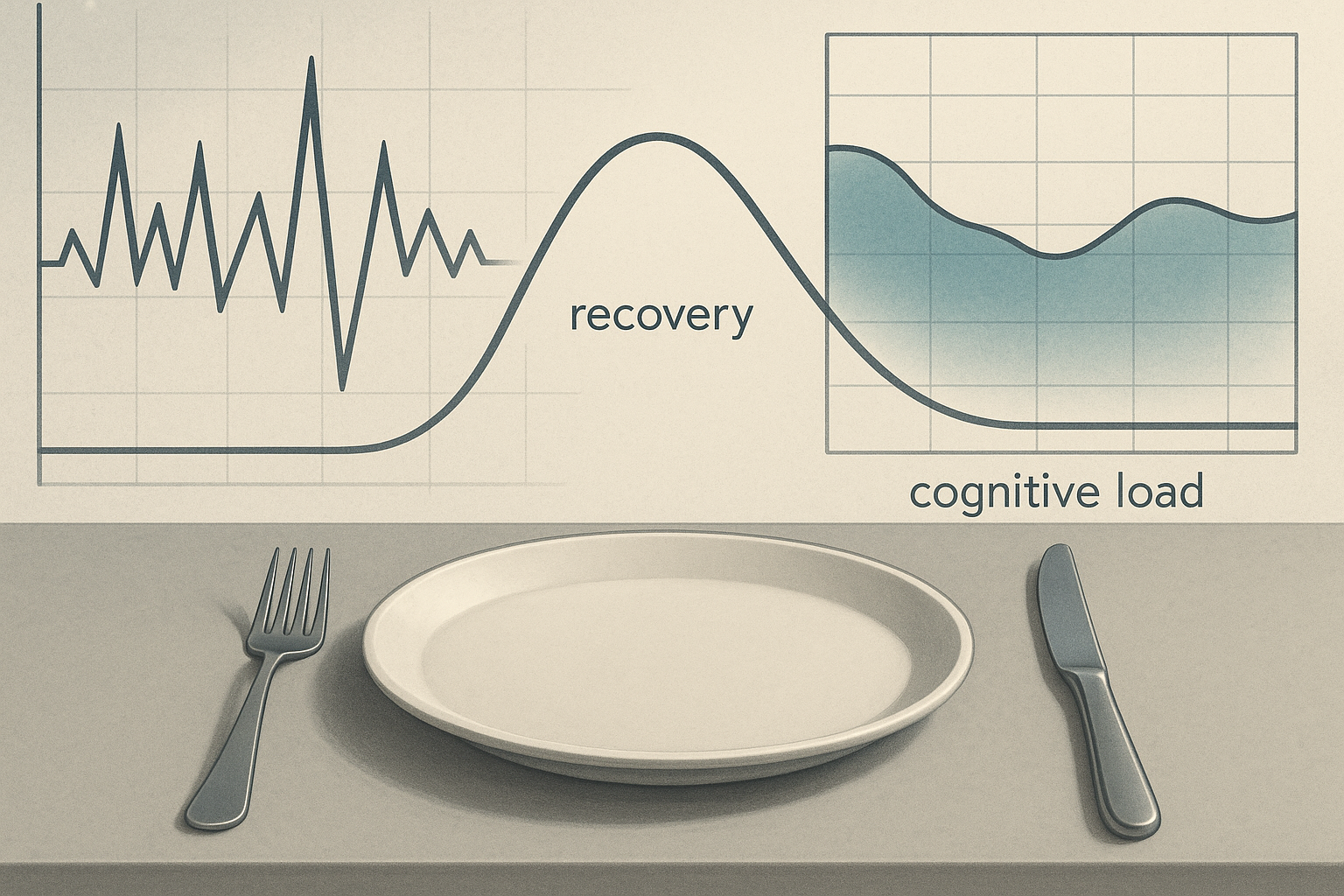
Irregular meals during the day: impact on stress, recovery, and cognitive load
Assess how meal discontinuity affects perceived stress, recovery debt, and cognitive overload. A premium test to identify hidden patterns and everyday imbalances.
Why this test exists
Irregular meals aren’t just a matter of “discipline.” They’re often an outcome (and sometimes a cause) of three forces that reinforce one another: stress load, recovery debt, and cognitive overload. When meal timing becomes fragmented, both body and mind have to compensate: energy swings, less stable attention, more reactive food choices, and less restorative sleep.
This test does not “diagnose” any condition and does not replace a professional. Its purpose is to make patterns visible that often remain implicit: what leads you to skip or delay meals, how you respond physiologically, and what it costs you in terms of mental clarity and recovery.
What we measure (operationally)
- Actual regularity: not intention, but the concrete variability of timing and the predictability of meals.
- Physiological reactivity: signals consistent with energy/attention swings and a “stop-and-start” approach to managing intake.
- Decision fatigue: how much managing food becomes a stream of repeated micro-decisions (what, when, how much), often under pressure.
- Recovery: how your eating pattern shows up in sleep, evening hunger, night awakenings, and your sense of restoration.
How to interpret the results
You will receive three profiling axes:
- axis_stress_load: how strongly your eating irregularity seems linked to pressure, urgency, activation, and “survival mode.”
- axis_recovery_debt: how much your pattern suggests insufficient recovery (sleep, breaks, decompression), making skipped meals or late compensation more likely.
- axis_cognitive_overload: how much food management is absorbed by mental load, interruptions, constant decision-making, and a lack of sustainable planning.
Important note: a high score is not “fault” or a “flaw.” It’s an indicator of cost: how much energy you’re spending to keep the day upright, and where the debt is accumulating.
Signals not to ignore
If you frequently recognize one or more of these elements, the test may be especially informative:
- sudden intense hunger—or no hunger for many hours—followed by evening compensation
- a drop in concentration, irritability, or “brain fog” when a meal gets pushed back
- pronounced sleepiness after late or very large meals
- night awakenings or light sleep linked to an irregular dinner
- using food as a tool for emotional regulation under pressure
Micro-actions (not generic advice): what to start observing today
Even before “fixing” anything, the goal is to measure. For 3 days, try recording only these three data points (without judgment):
- Time of your first and last meaningful caloric intake
- Reason for the delay (meeting, hyperfocus, anxiety, lack of options, forgetting, deliberate choice)
- Effect within 2 hours (energy, irritability, cravings, sleepiness, mental clarity)
This test will help you connect the dots: not just “I eat late,” but when it happens, why it happens, and what it costs.
Related deep dives
If you want to complete the picture, you may also want to explore:
Frequently asked questions
Is skipping breakfast always a problem?
Not necessarily. The point isn’t a single meal, but the combination of regularity, intake quality, and individual response. If skipping breakfast is a stable, sustainable choice and doesn’t trigger compensations (intense hunger, evening bingeing, cognitive dips), it can be neutral. If instead it’s driven by urgency, stress, or insufficient sleep, it’s often a sign of a broader imbalance.
Why do I become irritable or confused when I delay lunch?
For many people, the combination of energy deprivation, stress, and cognitive load increases reactivity: frustration tolerance worsens, mental flexibility decreases, and the tendency toward impulsive choices grows. It’s not just “hunger”: it’s a shift in the nervous system’s priorities toward managing urgency.
Can eating late at night affect sleep?
Yes, to varying degrees. A large or very late meal can increase physiological arousal, reflux, body temperature, and sleep fragmentation. In other cases, a dinner that’s too light after a day of restriction can lead to waking up hungry. The test aims to understand which pattern best matches your experience.
If I have days packed with meetings, how do I distinguish “lack of time” from a management issue?
The difference is predictability. If you know certain time slots are impractical but you have a minimal plan (ready options, a structured snack, a protected window), irregularity decreases. If instead every day requires improvised decisions, the cognitive cost rises and the likelihood of skipping/compensating increases.
Can this test indicate a metabolic or hormonal problem?
The test is not a diagnostic tool. However, it can highlight signals consistent with fluctuations in energy, hunger, and recovery that deserve attention. If you have significant symptoms (unintentional weight loss, fainting, rapid heartbeat, severe gastrointestinal issues, persistent insomnia), it’s appropriate to discuss them with a doctor or a nutrition professional.
What’s the difference between physiological hunger and “stress” hunger?
Physiological hunger tends to build gradually and is more flexible (you can choose what to eat). Stress-driven hunger can be sudden, specific (cravings), associated with urgency and a need for emotional regulation. In practice they often coexist: the test helps you understand when stress becomes the main driver.
Why does meal planning feel mentally exhausting?
Because it requires repeated decisions, forecasting, and managing constraints (time, availability, preferences, social context). Under cognitive overload, even simple tasks become costly. It’s not laziness: it’s an attention-budget problem. Reducing decisions (recurring menus, standard options) is often more effective than trying to “get motivated.”
How long does it take for greater regularity to produce noticeable effects?
It depends on your starting point and your level of stress/recovery. Some people notice differences in 3–7 days (more stable energy, fewer evening cravings). In other cases it takes longer because sleep and stress management need to realign. The best indicator is reduced compensations and decision fatigue, not perfect timing.