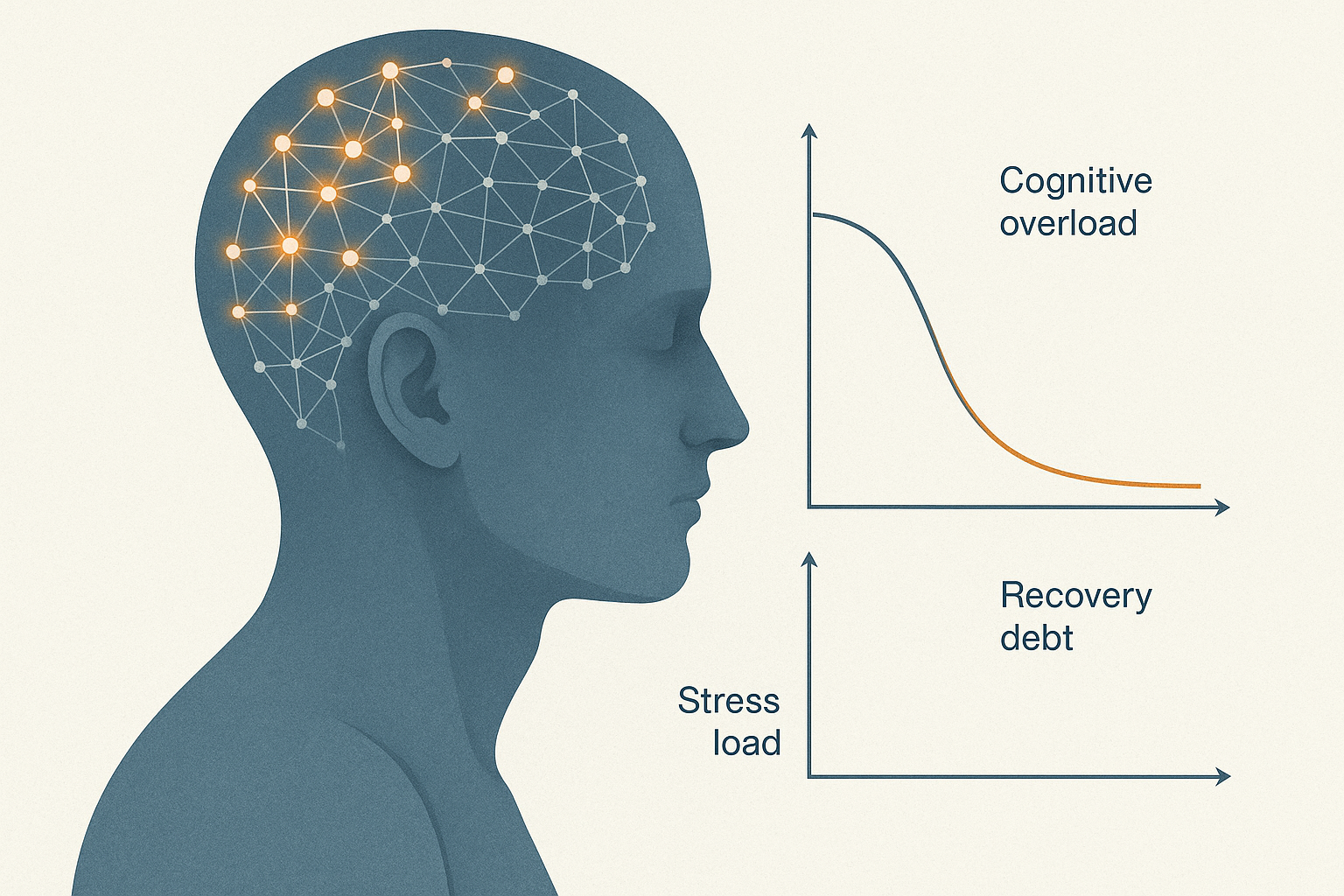
Assess whether you’re using stimulants to compensate for high stress, recovery debt, and cognitive overload. Results with axes: stress load, recovery debt, cognitive overload.
Why this test exists
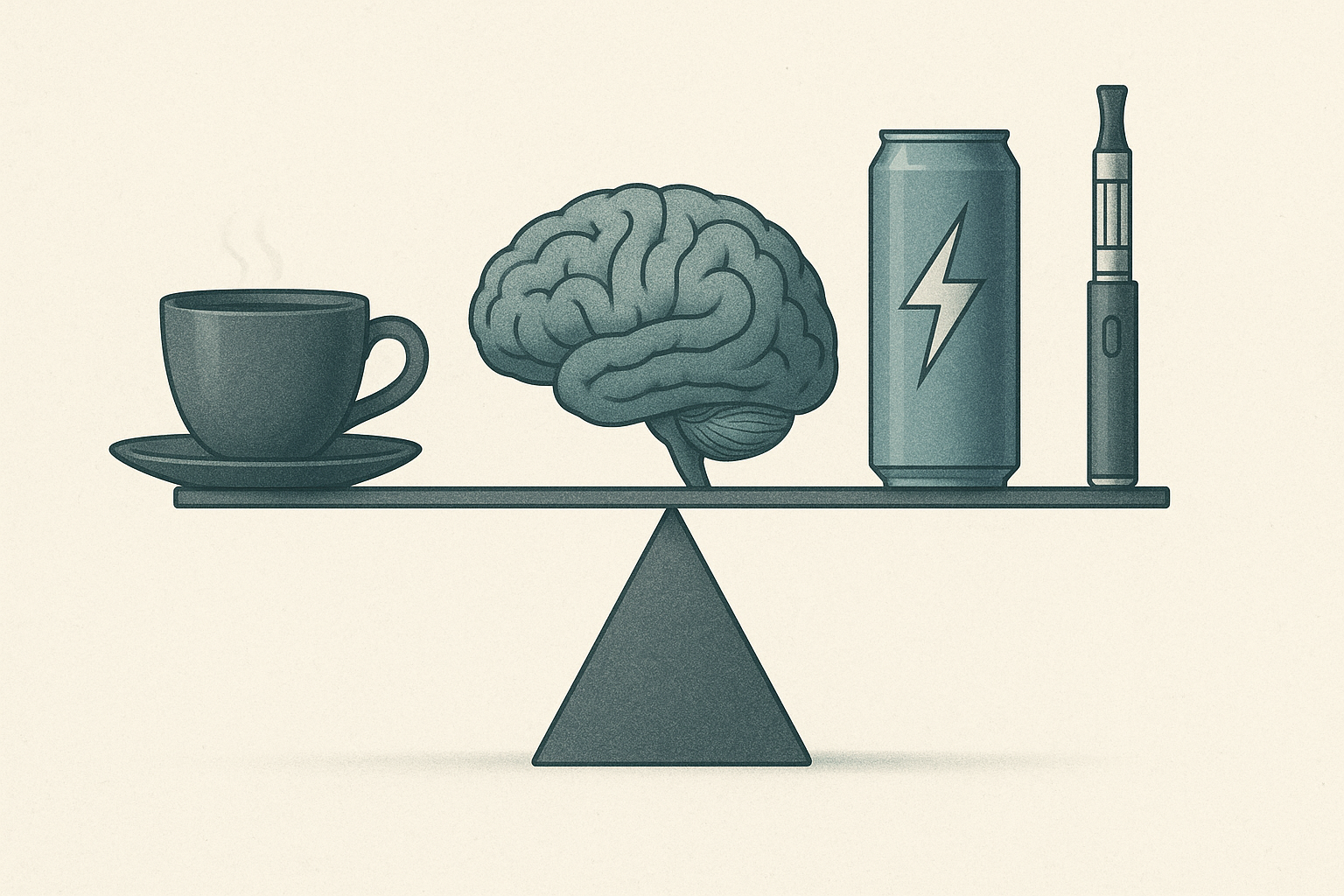
Many people aren’t “dependent” on stimulants in the clinical sense, but use them as a functional prosthesis: without caffeine, nicotine, energy drinks, or pre-workout, the day doesn’t get going, concentration doesn’t last, mood drops, or productivity collapses. This test doesn’t judge stimulant use; it measures how much your day-to-day functioning relies on an external push and which systems may be out of balance.
The goal isn’t to “quit” on principle. The goal is to understand whether you’re compensating for:
- stress load (high and persistent activation),
- recovery debt (sleep/rest insufficient relative to demand),
- cognitive overload (too many decisions, interruptions, complexity, informational noise).
What it measures (and what it doesn’t)
It measures
- Compensation patterns: when and why you seek stimulation.
- Tolerance and escalation: increasing dose/frequency to get the same effect.
- Physiological and behavioral costs: fragmented sleep, irritability, a “crash,” stress eating, attentional rigidity.
- Functional dependence: how much your baseline (energy, focus, initiative) depends on a substance or stimulating ritual.
It doesn’t measure
- A medical or psychiatric diagnosis.
- The clinical safety of medications or supplements.
- The presence of specific conditions (e.g., sleep disorders, ADHD, anxiety) that require professional evaluation.
How to answer to get a useful profile
- Answer with the last 2–4 weeks in mind, not your “ideal week.”
- Consider all sources: coffee, strong tea, mate, energy drinks, nicotine, gum/patches, pre-workout, cola drinks, micro-doses of stimulation (sugary snacks used as “ignition”).
- If your days vary a lot, answer based on the average or the most common scenario.
Interpreting results: three essential axes
The result isn’t a grade. It’s a map across three axes that often feed into one another:
- Stress Load: how much activation (pressure, urgency, perceived threat) you’re sustaining.
- Recovery Debt: how much recovery you’re missing relative to what you’re spending (sleep, breaks, decompression).
- Cognitive Overload: how much complexity and attentional fragmentation you’re managing.
High stimulant use can fit different profiles: for example, high stress with good recovery (stimulants as an accelerator), or high recovery debt with cognitive overload (stimulants as a crutch).
When it makes sense to dig deeper
Consider a clinical follow-up if you notice one or more persistent signs: insomnia or frequent awakenings, palpitations, pronounced anxiety, panic attacks, recurring headaches, a significant rise in blood pressure, using nicotine to regulate emotions, or combining multiple stimulants to “keep yourself going.”
If you’d like to read a broader framework on stress and recovery, see: Stress and recovery: how to read the body’s signals.
Frequently asked questions
How much caffeine is “too much”?
It depends on individual sensitivity, timing, and recovery status. In the literature, for many healthy adults 200–400 mg/day is often considered a moderate range, but it’s not a universal threshold. If you notice insomnia, irritability, tachycardia, tremors, or needing to increase the dose to get the same effect, the issue may be less “the amount” and more that caffeine is compensating for stress, sleep debt, or overload.
If I’m slow without coffee: is it dependence?
It could be tolerance/mild withdrawal (headache, sleepiness, low energy) or a sign that your baseline energy is low for structural reasons (insufficient sleep, unstable circadian rhythm, high mental load). The test distinguishes between “use for pleasure/ritual” and “use to function.”
Are energy drinks and pre-workouts different from coffee?
They often contain caffeine in high doses and combinations (taurine, guarana, sugars or sweeteners) that can increase activation and make the “crash” more abrupt. Also, the palatability and format make rapid intake easier. From a behavioral standpoint, they can reinforce a pattern of immediate ignition instead of load management.
Does nicotine count among stimulants “to function”?
Yes. Many people use it to modulate attention, anxiety, and irritability. The problem isn’t only chemical dependence: it’s using it as an emotional and cognitive regulator. If nicotine becomes your primary strategy to “get back online,” it’s an important indicator of stress load and recovery debt.
Why do I get sleepy after coffee?
It can happen for various reasons: high sleep debt (the boost isn’t enough), unfavorable timing relative to your circadian rhythm, rebound effect, or a conditioned association (coffee as a break cue). If post-coffee sleepiness is frequent, it often indicates you’re asking more of the system than it can sustain.
Can this test replace a medical evaluation of sleep or stress?
No. It’s a self-analysis tool: useful for identifying patterns and working hypotheses. If you have significant symptoms (severe insomnia, palpitations, intense anxiety, fainting episodes, combined use of stimulants, or rapid worsening), a clinical evaluation is recommended.
If I cut back on stimulants and feel worse: does that mean I need them?
Not necessarily. An initial worsening may reflect withdrawal, but also the emergence of the problem that stimulants were covering up (recovery debt, overload, stress). In these cases the useful question is: “What function was the stimulant serving in my system?”
How can I use the results in a practical way without generic advice?
Use the axes as a guide: if Stress Load is high, work on boundaries, urgency, and perceived pressure; if Recovery Debt is high, prioritize sleep, breaks, and decompression; if Cognitive Overload is high, reduce fragmentation, multitasking, and decision fatigue. For a methodological deep dive you can consult: <a href="{{internal:gestione-carico-cognitivo}}">Managing cognitive load</a>.