Why this test exists
Slow recovery after mental effort isn’t just “being tired.” It’s often the result of a combination of factors: a stress load that remains active even after the task is over, insufficient recovery accumulated over time, and a level of cognitive complexity (decisions, interruptions, ambiguity) that exceeds your capacity to regulate it.
This test doesn’t measure “how strong you are” or “how motivated you are.” It’s designed to identify patterns that make recovery inefficient: physiological signals, compensatory behaviors, and work/life conditions that keep your system in alert mode.
What it assesses (3 required axes)
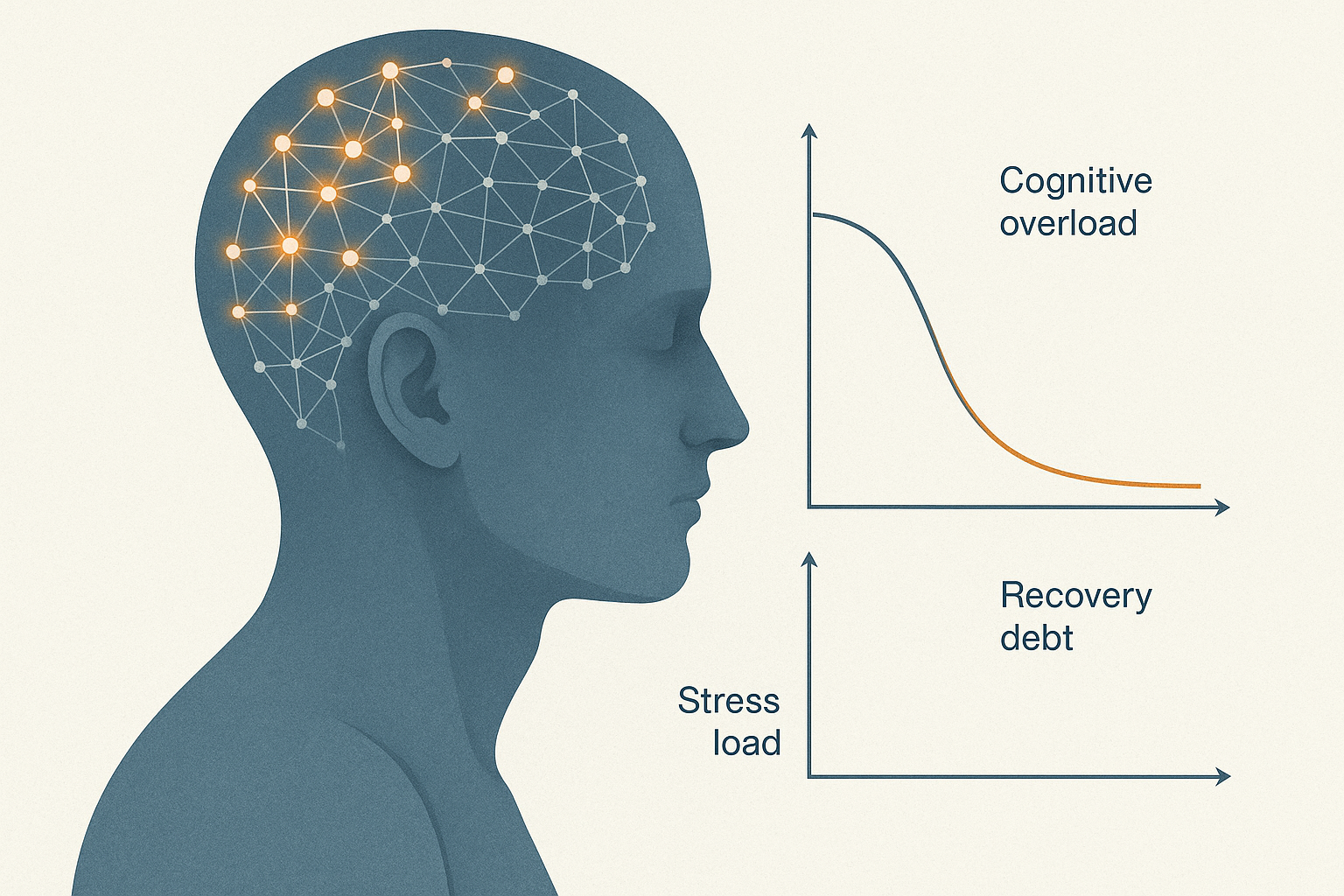
- Stress load (axis_stress_load): how often your system stays activated (tension, urgency, hypervigilance), and how quickly it returns to baseline.
- Recovery debt (axis_recovery_debt): how much recovery you’re “missing” compared to what you expend (sleep, breaks, decompression, emotional recovery).
- Cognitive overload (axis_cognitive_overload): how much mental complexity you’re handling (multitasking, context switching, decisions, informational noise), and what it costs you.
How to interpret the result
The result is not a diagnosis. It’s a probability map that helps you understand where to intervene: reduce load, increase recovery, or redesign how you manage attention.
In particular, slow recovery tends to emerge when:
- stress load is high and doesn’t switch off after the task;
- recovery debt is chronic (even with “enough sleep”);
- cognitive overload is high (too many decisions, too many interruptions, too many open variables).
Typical signs (not always obvious)
- Post-task inertia: you finish a mental task and stay “shut down” or irritable for hours.
- Apparent recovery: you distract yourself (scrolling, snacks, videos), but your mind stays active and doesn’t recharge.
- Decision fatigue: after many micro-decisions, even simple things start to feel heavy.
- Internal noise: rumination, replaying conversations, anticipating problems.
- Mild somatization: neck tension, a clenched jaw, shallow breathing, “screen” headaches.
When it makes sense to take this test
- If, after studying or doing mentally demanding work, you need many hours (or a full day) to feel clear-headed again.
- If you alternate between productivity peaks and crashes that are hard to predict.
- If rest doesn’t “sink in”: you sleep but don’t feel restored.
- If you notice your attention has become fragile (interruptions, distractions, irritability).
Method note
The questions are designed to capture recurring patterns over the past 2–4 weeks. Answer based on your actual frequency, not how it “should” be. If you’re going through an exceptional period (illness, bereavement, moving), keep in mind that the profile may mainly reflect that phase.
Further reading (optional)
If you want to better contextualize the result, you can cross-check it against other baseline profiles: