Operational Stress Management

Overload from simultaneous demands: map load, recovery debt, and cognitive overload

14 questions 7 min113 people have taken this test
Overload from simultaneous demands: map load, recovery debt, and cognitive overload

Assess how simultaneous demands affect operational stress, recovery debt, and cognitive overload. Identify hidden patterns and imbalance signals with a structured test.

Sign up or log in to take the test

Registration is required to start any test.

What this test analyzes

Operational stress load
Intensity and continuity of simultaneous demands, urgent situations, and perceived pressure. Assesses how often the system is in a state of alertness and reactive mode.
Recovery debt
Balance between exertion and recovery: sleep quality, decompression, genuine breaks, and the ability to mentally “switch off.” A high debt lowers your tolerance threshold and magnifies the cost of strain.
Cognitive overload
Saturation of attention and executive control: frequent task switching, loss of context, careless mistakes, decision fatigue, and difficulty initiating and completing tasks.

Why this test exists

Overload caused by simultaneous demands isn’t just “having a lot to do.” It’s a condition in which competing inputs (messages, urgencies, micro-decisions, context switching) exceed the system’s capacity to choose, hold, and complete tasks without significant physiological and cognitive costs.

This test does not measure your productivity. It measures three dimensions that are often conflated:

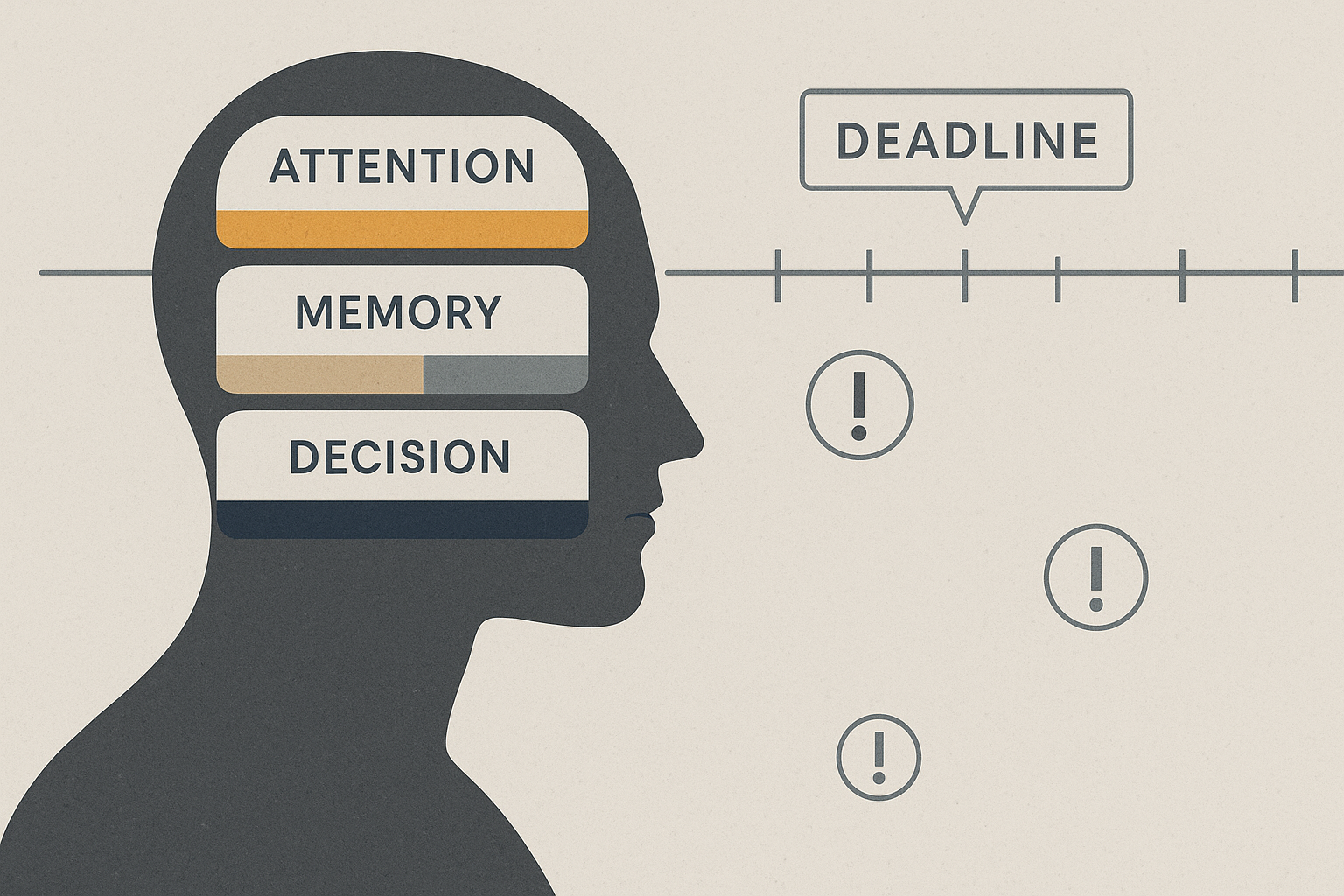
  • Stress load (axis_stress_load): the intensity and continuity of operational stressors.
  • Recovery debt (axis_recovery_debt): how much recovery you’re missing relative to what you expend (sleep, decompression, real breaks).
  • Cognitive overload (axis_cognitive_overload): saturation of attention, working memory, and executive control (mistakes, freezes, cognitive irritability).

What you’ll get (in practical terms)

At the end, you’ll receive a profile with:

  • Hidden patterns (e.g., “induced urgency,” “hyper-responsiveness,” “interruptions as the norm”).
  • Imbalance indicators between demand and recovery (early signals vs. established signals).
  • Operational hypotheses about what is sustaining the overload (processes, boundaries, expectations, digital environment).

Methodological note: the questions are phrased to reduce self-narration (“that’s just how I am”) and increase observation of repeated behaviors and bodily signals. This is not a medical diagnostic tool.

How to answer for a reliable result

  1. Consider the last 2 weeks (not just your most recent “day off”).
  2. Answer based on real situations: chats, email, requests from colleagues/clients, family, studying.
  3. If you’re torn between two options, choose the one that describes what happens more often, not what you wish would happen.

Interpretation: three axes you shouldn’t confuse

1) Stress load (axis_stress_load)

This refers to perceived pressure and the frequency of competing demands. A high load can be temporary (peaks) or chronic (the norm). The critical factor is continuity: when there are no low-demand windows, the system stays in an alert state.

2) Recovery debt (axis_recovery_debt)

This isn’t “not resting enough” in the abstract; it’s the negative balance between expenditure and restoration. You can have a moderate load but high debt if recovery is fragmented (interrupted sleep, screen-based breaks, rumination).

3) Cognitive overload (axis_cognitive_overload)

This is the often invisible part: difficulty keeping the thread, an increase in trivial mistakes, deferred decisions, irritability when new requests come in. It doesn’t necessarily mean “poor organization”: often it’s simply a bandwidth limit being exceeded.

When this test is especially useful

  • If your days are “interruption-driven” and you struggle to close loops.
  • If you notice that by evening you’re mentally saturated but haven’t done what mattered.
  • If you alternate between hyperactivity and freezes, or if your tolerance threshold for demands has dropped.

Related deep dives (optional)

If you want to put your result in context, you can explore:
Frequently asked questions

Does this test measure whether I’m “good” at handling stress?
No. It measures three functional dimensions (stress load, recovery debt, cognitive overload) and how they tend to combine. The goal is to describe your current state, not to assign a value judgment.
What’s the difference between multitasking and simultaneous demands?
Multitasking is a strategy (often inefficient) of rapidly switching between tasks. Simultaneous demands are an environmental condition: more inputs compete within the same time window (notifications, urgencies, people). You can be forced to handle simultaneous demands even without choosing multitasking.
If my load is high but my recovery debt is low, what does that mean?
It indicates that, despite many demands, you’re recovering sufficiently (sleep, real breaks, decompression). In these cases the main risk is cognitive overload from fragmentation: many transitions can increase errors and decision fatigue even with good recovery.
If recovery debt is high but the load doesn’t seem extreme, why do I feel so bad?
Because insufficient recovery lowers your tolerance threshold: moderate demands become “too much.” Also, recovery debt affects attention, emotional regulation, and the ability to inhibit distractions, amplifying the perception of pressure.
How reliable are the answers if I’ve had an unusual week?
The test is calibrated to the last two weeks to reduce the effect of isolated spikes. If you’ve had an exceptional event (extraordinary deadline, illness, travel), consider taking it again in 10–14 days to compare profiles.
Can this test replace a clinical assessment?
No. It’s a self-analysis tool aimed at awareness and autonomy. If persistent insomnia, panic attacks, depressive symptoms, substance abuse, or significant impairment in daily functioning are present, it’s advisable to consult a healthcare professional.
What can I do if high cognitive overload emerges?
The first step is to reduce unnecessary transitions (interruptions, switching) and increase work windows with a stable context. In parallel, check your recovery debt: without restoration, even good organization won’t hold for long. The final report will indicate which levers are most consistent with your answers.
Why do some questions involve the body (sleep, tension, appetite)?
Because overload isn’t only mental: it’s a physiological adaptation. Signals like fragmented sleep, muscle tension, or changes in appetite are useful indicators for distinguishing a manageable spike from a state that’s becoming chronic.

Recommended tests

All tests