Operational Stress Management

Mental fatigue during work peaks: load map, recovery, and cognitive overload

16 questions 8 min45 people have taken this test
Mental fatigue during work peaks: load map, recovery, and cognitive overload

Assess how you respond to work peaks: stress load, recovery debt, and cognitive overload. Identify hidden patterns, physiological and behavioral signals, and areas of operational risk.

Sign up or log in to take the test

Registration is required to start any test.

What this test analyzes

Intensity and continuity of operational demands, urgency, interruptions, and time pressure, shaped by the perceived ability to control priorities.
Gap between the recovery you need and the recovery you’re actually getting: sleep, decompression, real breaks, mental detachment, and the physiological signs that your reset didn’t work.
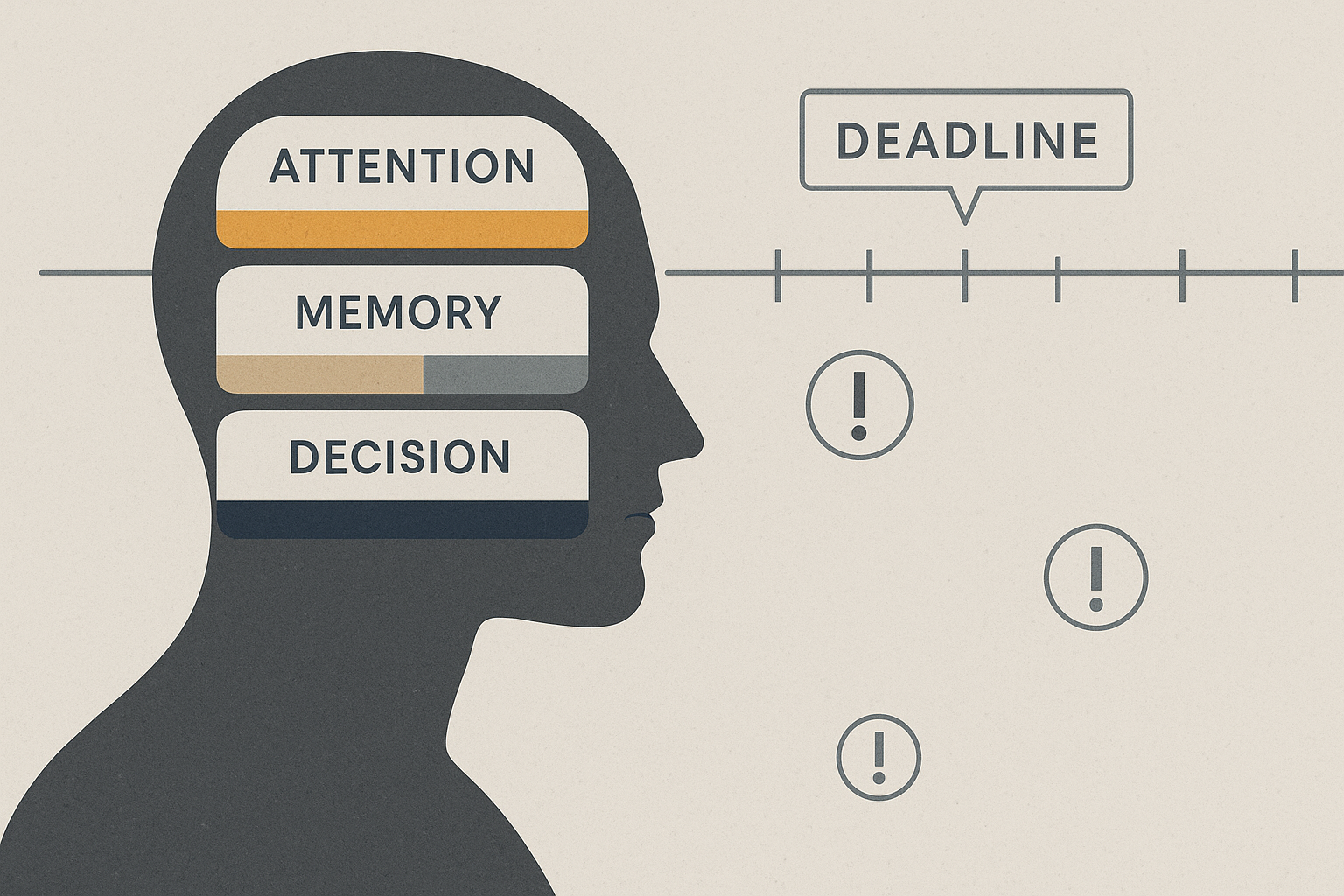
Saturation of mental resources (attention, working memory, and decision-making), affecting error rates, task switching, task initiation, and the quality of judgment.

Why this test exists

During peak workloads, mental fatigue isn’t just “tiredness”: it’s a measurable combination of stress load, insufficient recovery, and cognitive overload. When these three factors add up, the mind tends to lose precision: errors, irritability, slower response times, rigid decision-making, and compensatory behaviors (over-control, procrastination, digital micro-escapes) increase.

This test isn’t meant to entertain you or “motivate” you. It’s meant to make patterns visible that often remain implicit: how you react under pressure, how much it costs you to recover, and which early signals indicate you’re exceeding your functional threshold.

What we measure (3 required axes)

1) Stress load (axis_stress_load)

How much your system is exposed to demands, urgency, competing priorities, and time pressure. It’s not just about “how much work” you have, but how much non-negotiable work you have—and how much room for control you feel you have.

2) Recovery debt (axis_recovery_debt)

How much recovery you’re missing compared to what you need to return to a stable baseline. It includes sleep, decompression, real breaks, the quality of mental detachment, and physiological signals (tension, appetite, somatic symptoms).

3) Cognitive overload (axis_cognitive_overload)

How saturated your capacity for attention, working memory, and decision-making is. It shows up as fragmentation, difficulty keeping the thread, increased multitasking, a drop in thinking quality, and “mental noise.”

How to answer (to get a useful profile)

  • Answer with the last 14 days in mind (not your best or worst day).
  • If you work in cycles (closures, sprints, shifts), consider the last full peak.
  • Don’t look for the “right” answer: what matters here is the actual frequency and the operational impact.

How to read the result (interpretive logic)

The value of the test isn’t an absolute score, but the combination of the three axes:

  • High stress load + high recovery debt: risk of stretching the peak beyond its physiological duration; performance may remain “upright,” but at an increasing cost.
  • High stress load + high cognitive overload: risk of errors, conflicts, impulsive or overly analytical decisions; micro-interruptions and loss of priorities often appear.
  • High recovery debt + high cognitive overload: the mind becomes less flexible; rumination, irritability, and difficulty switching off even after work ends increase.
  • All three high: it’s not “weakness”—it’s a system signal. You need to reduce inputs, increase recovery, and protect decision-making capacity.

If you want to go deeper, you can compare this profile with other tools on the platform: signs of operational stress and burnout risk and micro-breaks and recovery hygiene.

Responsibility note

This test is a self-assessment tool and does not replace clinical evaluation. If you have persistent insomnia, panic attacks, depressive symptoms, substance misuse, or a marked decline in day-to-day functioning, it’s advisable to discuss it with a healthcare professional.


Frequently asked questions

Does this test measure stress “in general” or work-related stress?
It measures stress in an operational context: demands, urgency, priority conflicts, and work-related cognitive load (or equivalent responsibilities). It’s not a global indicator of psychological well-being, but a functional map of how you handle peak pressure.
Why do you include “recovery debt” and not just sleep?
Because recovery doesn’t coincide with hours slept. Recovery debt includes sleep quality, mental detachment, real breaks, physiological decompression, and bodily signals. Two people with the same amount of sleep can have very different recovery debt.
What’s the difference between cognitive overload and stress load?
Stress load describes external pressure and perceived control (urgency, demands, interruptions). Cognitive overload describes the internal saturation of mental resources (attention, working memory, decision-making). They can move together, but not always: you can have many demands with good mental clarity, or few demands but a mind that’s already saturated.
If I get high scores, does that mean I’m heading toward burnout?
Not automatically. High scores indicate an operational risk profile: you’re paying a high cost to maintain performance. Burnout is a possible outcome when exposure is prolonged and recovery remains insufficient, but it requires a broader assessment (duration, symptoms, context, resources).
How often does it make sense to repeat the test?
During peak periods: every 2–4 weeks. During stable periods: every 6–8 weeks. The goal is to observe trends (accumulation or recovery), not chase day-to-day fluctuations.
Can I “cheat” without realizing it? (e.g., minimizing or dramatizing)
Yes: it’s common. To reduce bias, answer based on the last 14 days and use concrete indicators (mistakes, timing, interruptions, sleep, irritability, somatic symptoms). If you notice yourself swinging between minimizing and alarming, that’s already data: it often signals unstable recovery or prolonged pressure.
What makes this test different from a motivational questionnaire?
It doesn’t offer slogans or generic advice. It uses items oriented toward observable signals (behaviors, physiology, attention quality, decision-making) and separates three axes that are often conflated. The result is a more useful map for understanding where to intervene: load, recovery, or cognitive capacity.

Recommended tests

All tests