Peptides & Regenerative Optimization
Regenerative capacity and age: stress, recovery, and cognitive overload
Assess signs of reduced regenerative capacity with age: stress load, recovery debt, and cognitive overload. Results oriented toward awareness and autonomy.
Why this test exists
As we age, regenerative capacity tends to decline. It’s not just that “you recover more slowly”—stress tolerance, sleep quality, energy stability, and the ability to restore attention and motivation after intense demands can change as well. This test doesn’t measure “how fit you are,” and it doesn’t promise shortcuts. Its purpose is to make visible patterns that are often normalized (or attributed to personality, laziness, or a lack of discipline).
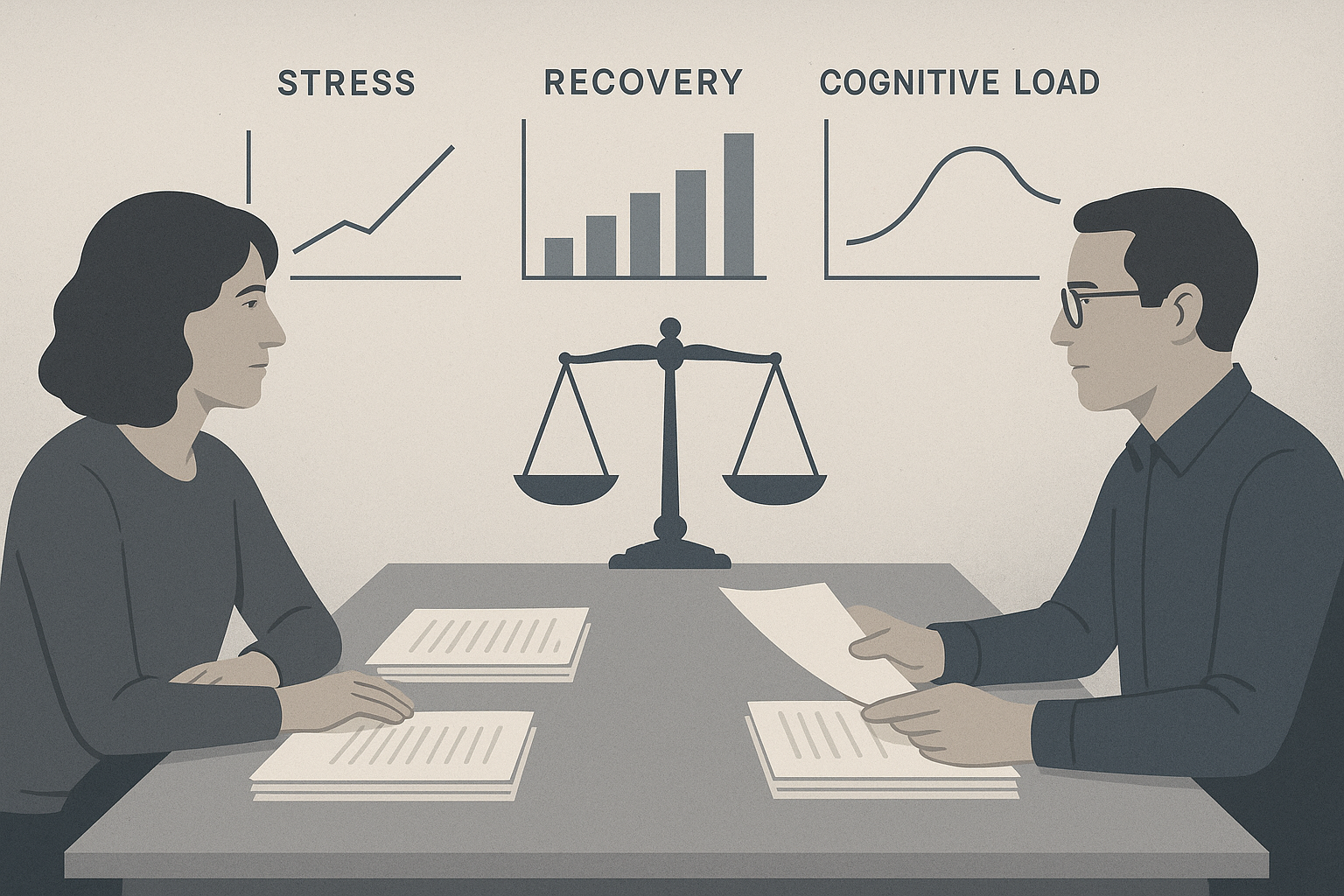
It focuses on three axes that, when they fall out of alignment, can mimic or amplify functional aging:
- Stress load (how much demand the system is under)
- Recovery debt (how much recovery is truly missing, even if you “stop”)
- Cognitive overload (how saturated the mind is with complexity, decisions, and task-switching)
What it assesses (and what it doesn’t)
It assesses
- Signs of incomplete recovery (non-restorative sleep, morning inertia, weekend rebound).
- Indicators of persistent stress (tension, hyperarousal, irritability, somatization).
- Patterns of cognitive overload (decision fatigue, reduced working memory, difficulty “closing loops”).
- Alignment between load (work, training, responsibilities) and restorative capacity.
It does not assess
- Medical or endocrine diagnoses (e.g., hypothyroidism, anemia, sleep apnea).
- The effectiveness or appropriateness of peptides/medications: the test is behavioral and physiological-perceptual.
How to answer to get a useful profile
- Answer with the last 2–4 weeks in mind—not “when you’re on vacation.”
- If you’re going through an unusual period (flu, moving, bereavement), answer anyway: the test captures your current state.
- Avoid self-judgment: what matters here is the consistency of the pattern, not willpower.
Interpretation: what “regenerative decline” means in practice
Functionally, reduced regenerative capacity often shows up as:
- Slower recovery after physical or mental stress (prolonged DOMS, post-load “fog”).
- A higher cost to maintain normal performance (more caffeine, more effort, more irritability).
- Less elasticity: small, unexpected events destabilize sleep, mood, appetite, or focus.
The goal isn’t to “accept decline,” but to understand which axis is driving the deterioration: high stress, insufficient recovery, cognitive overload (or combinations).
Further reading (optional)
If you’d like to put your results in context using other modules on the platform, you can explore:
Note: these links are optional and not required to complete the test.
Frequently asked questions
Does this test really measure “regeneration,” or is it just a stress questionnaire?
It measures functional indicators related to regeneration: recovery quality, energy stability, load tolerance, and cognitive saturation. It does not replace biomarkers or clinical assessments, but it can highlight patterns consistent with inefficient recovery that, over time, reduces adaptive capacity.
Why do you include cognitive overload in a topic related to age?
Because cognitive overload increases the physiological cost of day-to-day functioning: more switching, more decisions, more informational noise. This can worsen sleep, energy variability, and recovery, mimicking “accelerated aging” at a functional level.
If I have high stress but good recovery, should I be worried?
Not necessarily. High stress with good recovery can indicate a sustainable load phase. Risk emerges when stress stays high and recovery starts to deteriorate (recovery debt), or when cognitive overload prevents you from “unloading” even when you have free time.
What’s the difference between fatigue and recovery debt?
Fatigue can be an acute, reversible signal. Recovery debt is an accumulation: even if you sleep or rest, you don’t return to baseline, or you do only with long and disproportionate breaks. It’s often accompanied by unrefreshing sleep, irritability, and a drop in mental performance.
Can the results suggest that I need peptides or supplements?
No. The test does not provide therapeutic recommendations. However, it can help you understand whether the issue is mainly load, recovery, or cognitive overload—useful information to discuss with a professional and to set measurable behavioral changes.
How reliable is it if I train a lot or have a physically demanding job?
It’s precisely in these cases that the distinction between load and recovery becomes informative. Answer based on what’s normal for you over the last 2–4 weeks. If physical load is high, the test can show whether recovery is adequate or whether you’re accumulating debt.
What if the problem is medical (thyroid, anemia, sleep apnea)?
It’s possible. If high scores emerge for recovery debt along with unrefreshing sleep, marked daytime sleepiness, or a sudden drop in performance, consider a clinical evaluation. The test is an awareness filter, not a diagnostic tool.