Natural Rhythms & Environmental Exposure
Prolonged time spent indoors: stress, recovery debt, and cognitive overload
Assess how prolonged time spent indoors can affect stress load, recovery debt, and cognitive overload. Results are oriented toward patterns and imbalances, not labels.
Why this test exists
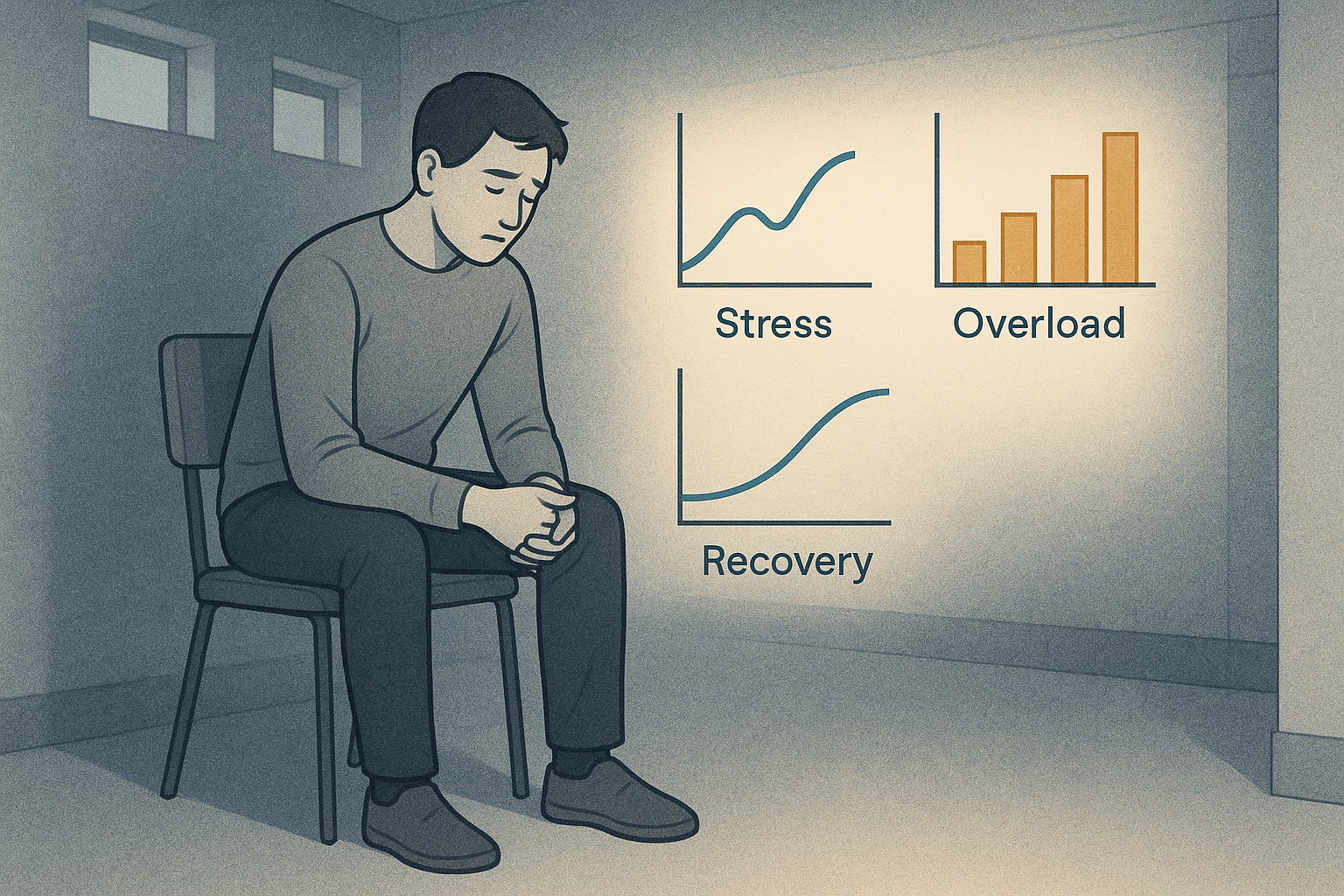
Spending long periods indoors is not just a “work condition”: it is a physiological context. It changes your exposure to natural light, air quality, sensory variability, spontaneous movement, and social cues. Taken together, these factors can affect three key dimensions:
- Stress load (how often your system is on alert and how often it has to “hold it together”)
- Recovery debt (how much recovery you’re missing relative to what you expend)
- Cognitive overload (how much your mind is forced to filter, decide, and compensate)
This test is not intended to diagnose. It is meant to make patterns visible that are often normalized (“it’s just tiredness,” “it’s just stress”).
What we measure (operationally)
axis_stress_load — Stress load
Typical indicators: hypervigilance, irritability, physical tension, reactivity to the unexpected, difficulty “switching off” even when there is no real urgency.
axis_recovery_debt — Recovery debt
Typical indicators: non-restorative sleep, reliance on compensations (caffeine, sugar, scrolling), reduced resilience, morning sluggishness, insufficient recovery between similar days.
axis_cognitive_overload — Cognitive overload
Typical indicators: decision fatigue, difficulty sustaining concentration, unstable working memory, a feeling of a “full mind,” an increase in mistakes or forgetfulness.
How to answer to get a useful profile
- Answer with the last 2–4 weeks in mind, not a single day.
- If you alternate between different environments, think about the one where you spend the most hours.
- Don’t look for the “right” answer: what matters here is frequency and impact.
Interpretation: what may emerge
Three examples of patterns that are often confused with one another:
- High stress + low recovery: the system stays activated and doesn’t come back down; fatigue becomes “background noise.”
- Moderate stress + high overload: you may not necessarily feel anxious, but your mind is saturated by micro-decisions, interruptions, repetitive stimuli, or low environmental variability.
- Low recovery with unrecognized stress: the body pays the bill (sleep, energy, immunity), while the mind has adapted and no longer signals alarm.
If you want to explore the underlying mechanisms, you can consult: circadian rhythm and environmental cues and recovery hygiene.
Safety note
If you are experiencing severe insomnia, panic attacks, significant depressive symptoms, or a rapid decline in daily functioning, this test can provide initial orientation but does not replace a clinical assessment.
Frequently asked questions
Does this test assess air quality or light in an “objective” way?
No. It assesses the functional impact your indoor environment is having on stress, recovery, and cognitive load. It doesn’t measure CO₂, VOCs, or lux: it measures indirect signals (sleep, energy, attention, reactivity) that often anticipate the issue or make it evident.
Why can spending time indoors increase cognitive overload?
Because it reduces sensory variability and often increases the need to compensate: more noise filtering, more digital interruptions, more micro-decisions (posture, comfort, temperature), fewer natural cues for the “start/end” of phases of the day. The result can be a mind constantly engaged in stabilizing the context.
If I work from home, is the risk automatically higher?
Not automatically. It depends on natural light, opportunities for movement, air quality, boundaries between work and recovery, noise, and your ability to create transitions. Some people improve a lot working from home; others accumulate recovery debt because the day loses structure.
What’s the difference between stress load and recovery debt?
Stress load is about activation (how often you’re in “alert/control” mode). Recovery debt is about balance (how much recovery is missing relative to expenditure). You can have high stress but recover well, or low perceived stress but insufficient recovery.
Can I get “high” results on all three axes?
Yes. It’s a typical profile when the indoor environment is poorly regulating (low light, stale air, noise/interruptions) and the routine doesn’t include real breaks. In these cases the priority isn’t “do more,” but reduce demands and increase recovery cues.
How often should I repeat the test?
It makes sense to repeat it after 2–4 weeks if you’re changing your context (light exposure, breaks, ventilation, movement) or if your workload changes. Repeating it too soon tends to capture day-to-day fluctuations rather than trends.
Does the test distinguish between physical and mental fatigue?
Partly. Some questions separate bodily energy (heaviness, sleepiness, tension) from cognitive signals (errors, working memory, decision fatigue). However, the two domains often influence each other: the value lies in the overall pattern.