Why this test exists
Trust isn’t a “personality” trait: it’s an operational estimate people make about you, based on repeated signals. In day-to-day work, the team evaluates (often without saying so) three things:
- Predictability: how consistent you are across your words, decisions, and behaviors.
- Safety: how risky it feels to bring you problems, mistakes, or dissent.
- Relational competence: how well you handle pressure, ambiguity, and priorities without shifting invisible costs onto others.
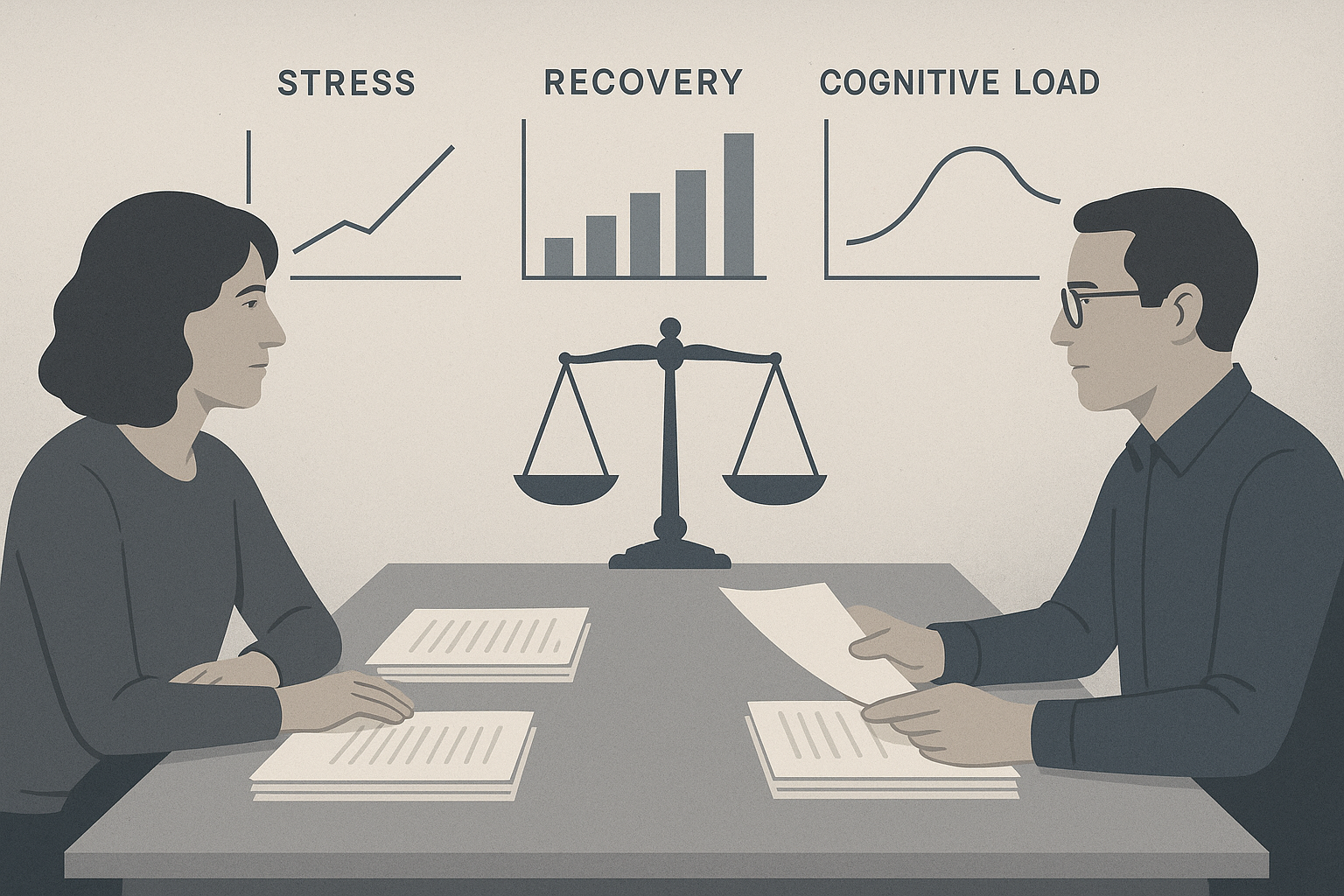
This test doesn’t measure “how good a leader you are.” It measures patterns that increase or reduce perceived trust, including three often-overlooked variables: stress load, recovery debt, and cognitive overload. These physiological and mental conditions change micro-behaviors (tone, timing, rigidity, reactivity) that the team reads as signals of reliability or risk.
What you’ll get
- Signal map: where your style builds trust—and where it erodes it.
- Imbalance indicators: when stress, insufficient recovery, or cognitive overload are “driving” your interactions.
- Testable hypotheses: specific points to observe over the next two weeks (not generic advice).
How to answer (to avoid self-deception)
- Answer with the last 30 days in mind, not your ideal intentions.
- If you’re torn between two options, choose the more frequent one.
- Also think about moments under pressure: that’s where trust is reinforced—or broken.
What “perceived trust” really measures
In a team, trust is often a combination of:
- Behavioral integrity: you do what you say, and you explain when you can’t.
- Decision competence: you can decide, prioritize, and course-correct without blaming others.
- Emotional regulation: you don’t turn your tension into a threat to others.
- Uncertainty management: you communicate limits and hypotheses without creating chaos.
Three cross-cutting axes influence all of this:
- Stress load (axis_stress_load): how often you operate in “alarm” mode.
- Recovery debt (axis_recovery_debt): how much you’re paying in energy, sleep, and self-regulation capacity.
- Cognitive overload (axis_cognitive_overload): how much complexity you’re handling without margin, increasing the risk of errors and inconsistencies.
Interpretation: typical signals when trust drops
If perceived trust declines, it’s often not due to a single event, but to a build-up of micro-signals:
- implicit promises left open (missing follow-up, decisions left pending);
- priority shifts without explaining the rationale;
- feedback given only in emergencies or only when something goes wrong;
- unpredictable emotional reactions (cutting irony, sudden coldness, impatience);
- urgent requests that become “normal,” eroding people’s sense of control.
The test helps you understand which of these signals are more likely in your case—and which internal conditions may be amplifying them.
Related deep dives
If you want to round out the picture with other indicators, you can also use:
- Stress & Recovery Profile (to distinguish “functional” stress from stress that degrades the relationship).
- Decision-making style under pressure (to understand how you change when your margin shrinks).
Responsibility note
This test is a self-analysis tool and does not replace clinical or organizational assessments. If you recognize persistent signs of burnout, insomnia, or emotional dysregulation, consider speaking with a qualified professional.