Adaptability & Organizational Change

Stress during transition phases: load, recovery, and cognitive overload

14 questions 7 min89 people have taken this test
Stress during transition phases: load, recovery, and cognitive overload

Assess how phases of change (new role, reorganization, uncertainty) affect stress load, recovery debt, and cognitive overload. Results geared toward awareness and autonomy.

Sign up or log in to take the test

Registration is required to start any test.

What this test analyzes

Intensity and persistence of pressure during the transition: ambiguity, conflicting priorities, social exposure, and responsibility without control.
The gap between energy expended and genuine recovery: sleep quality, decompression time, the ability to switch off, and the physical signs of prolonged activation.
Saturation of working memory and decision-making capacity: task switching, fragmentation, rumination, repeated double-checking, and difficulty closing loops.

Why this test exists

Organizational transitions (a new role, reorganization, leadership changes, mergers, new metrics, hybrid work) don’t “just add more work”: they change the rules of the game. When the rules change, the nervous system becomes more vigilant, the mind scans for signals, and the body reallocates resources toward alertness and control. This can boost apparent performance in the short term, but often at the expense of recovery, decision clarity, and emotional stability.

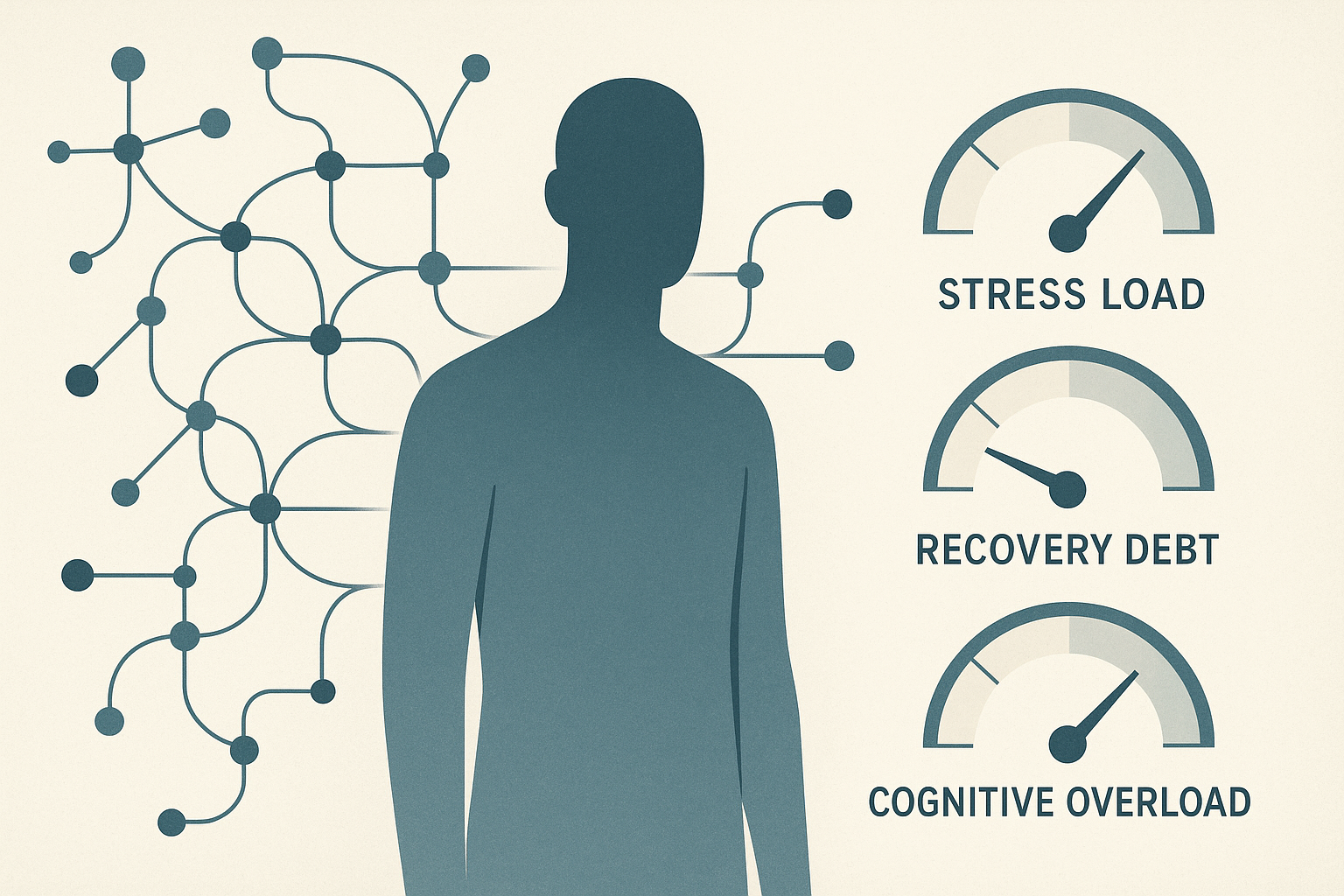
This test does not measure your “resilience” as a moral trait. It maps three functional axes that tend to become misaligned during transitions:

  • Stress load: how much pressure you’re absorbing—and for how long.
  • Recovery debt: how much recovery you’re missing relative to what you’re spending.
  • Cognitive overload: how much mental capacity is consumed by uncertainty, context switching, decisions, and informational noise.

What you’ll get (and what you won’t)

You’ll get

  • A snapshot of your patterns over the last 2–3 weeks (the typical transition window).
  • Imbalance indicators: where you’re “holding” things in your head that your body isn’t recovering from.
  • Operational language to describe the problem (useful with a manager, HR, a therapist, or a doctor).

You won’t get

  • Clinical diagnoses.
  • Generic advice like “relax” or “think positive.”

How to answer for a reliable result

  1. Refer to the last 2–3 weeks, not to “what you’re like in general.”
  2. If you’ve experienced acute events (flu, bereavement, moving), keep in mind they can inflate your scores.
  3. Answer based on observable behaviors (sleep, decisions, mistakes, irritability), not self-judgments.

If you want to explore the overall picture further, you can combine this test with the stress–recovery system map and the cognitive load audit.

Interpretation: the three axes during transition

1) Stress load (axis_stress_load)

It’s not just “how much work you have.” It’s the combination of time pressure, ambiguity, social exposure (being evaluated), conflicting priorities, and responsibility without control. During transitions, load can rise even when hours don’t—because decision friction increases.

2) Recovery debt (axis_recovery_debt)

Recovery isn’t the same as “doing nothing.” It’s the ability to return to baseline: effective sleep, decompression, digestion, emotional flexibility, and the ability to switch off. Debt accumulates when the system stays activated even outside working hours.

3) Cognitive overload (axis_cognitive_overload)

During change, the mind has to update its models: new rules, new people, new metrics. If notifications, fragmented meetings, and context switching also increase, working memory gets saturated. The typical result isn’t “I don’t understand anything,” but rather forgetfulness, irritability, delayed decisions, and evening rumination.

When to take the result seriously

Consider the result an operational signal if you recognize at least one of these scenarios:

  • You’re “functioning,” but at a growing cost (sleep, mood, body).
  • You feel more reactive: less tolerance, more conflict, or more withdrawal.
  • Your attention is more fragile: you start many things and finish few.

If intense or persistent symptoms emerge (severe insomnia, panic attacks, increasing use of alcohol/substances, thoughts of self-harm), this test is not a substitute for clinical support: it’s appropriate to discuss it with a healthcare professional.

Frequently asked questions

Does this test measure stress “in general,” or stress related to change?
It’s designed for stress in transition contexts: when rules, expectations, roles, or boundaries change. The questions are calibrated to ambiguity, switching, social pressure, and impaired recovery—typical of organizational change.
How soon can I see changes in my scores?
Often within 10–21 days, because the three dimensions respond quickly to changes in workload, sleep quality, work fragmentation, and clarity of priorities. If the transition is structural (a new role), scores may stabilize more slowly.
If I have a high stress-load score but a low recovery-debt score, is that possible?
Yes. It indicates you’re carrying a high load but still recovering sufficiently (effective sleep, real decompression, boundaries). It’s a “sustainable” configuration in the short term, but it should be monitored: if the load stays high, recovery debt tends to increase.
What’s the difference between cognitive overload and anxiety?
Cognitive overload is about saturated mental capacity (working memory, switching, decision fatigue). Anxiety is an emotional-physiological state of threat. During transitions they often coexist: overload increases errors and uncertainty, which in turn fuel anxiety.
Can the test help me understand whether I’m heading toward burnout?
It can signal a risk trajectory when these coexist: high load, high recovery debt, and high cognitive overload. It’s not a burnout diagnosis, but an early map of conditions that make it more likely.
How should I answer if some weeks have been “atypical” (travel, illness, deadlines)?
Answer based on the last 2–3 weeks anyway, and treat the anomaly as part of the context. If the event was exceptional and already over, you can repeat the test after 10–14 days to distinguish an acute spike from a pattern.
Can I use the result to talk with my manager or HR?
Yes, if you use it as descriptive language: which factors increase load (ambiguity, priority conflicts), what prevents recovery (being on call, evening meetings), what saturates the mind (switching, notifications). It’s more useful than a generic request for “less stress.”
Is this test also suitable for people who work remotely or in a hybrid setup?
Yes. In remote/hybrid work, fragmentation, porous boundaries, and hyper-asynchronous communication often increase—conditions that directly affect recovery debt and cognitive overload.

Recommended tests

All tests