Why take a test on adopting new procedures
When an organization introduces new procedures, it rarely changes only “how things are done.” Attention, priorities, decision load, pace, and often your sense of control change as well. Acceptance (or rejection) isn’t a moral trait: it’s an outcome that emerges from the interaction between contextual demands and available resources.
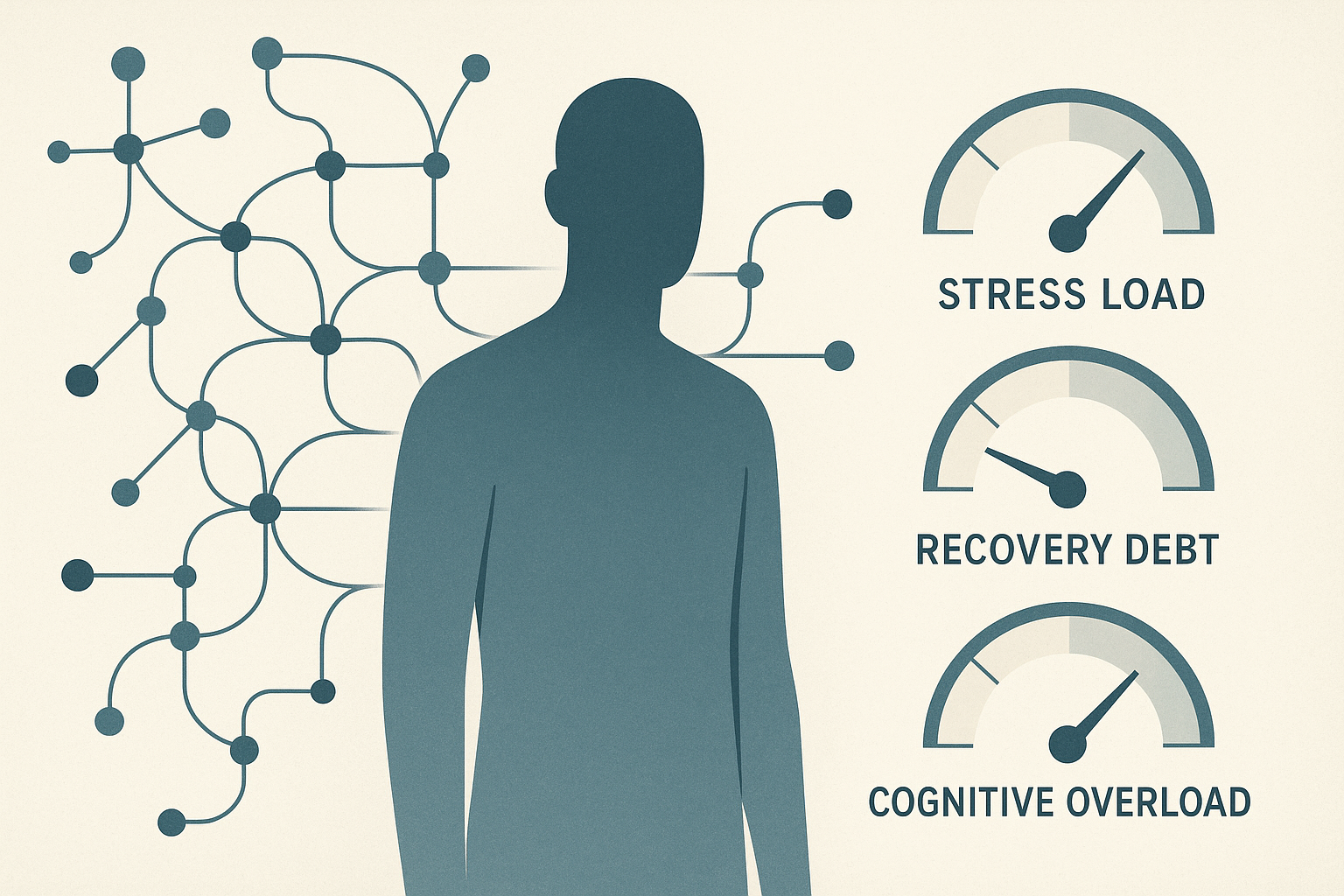
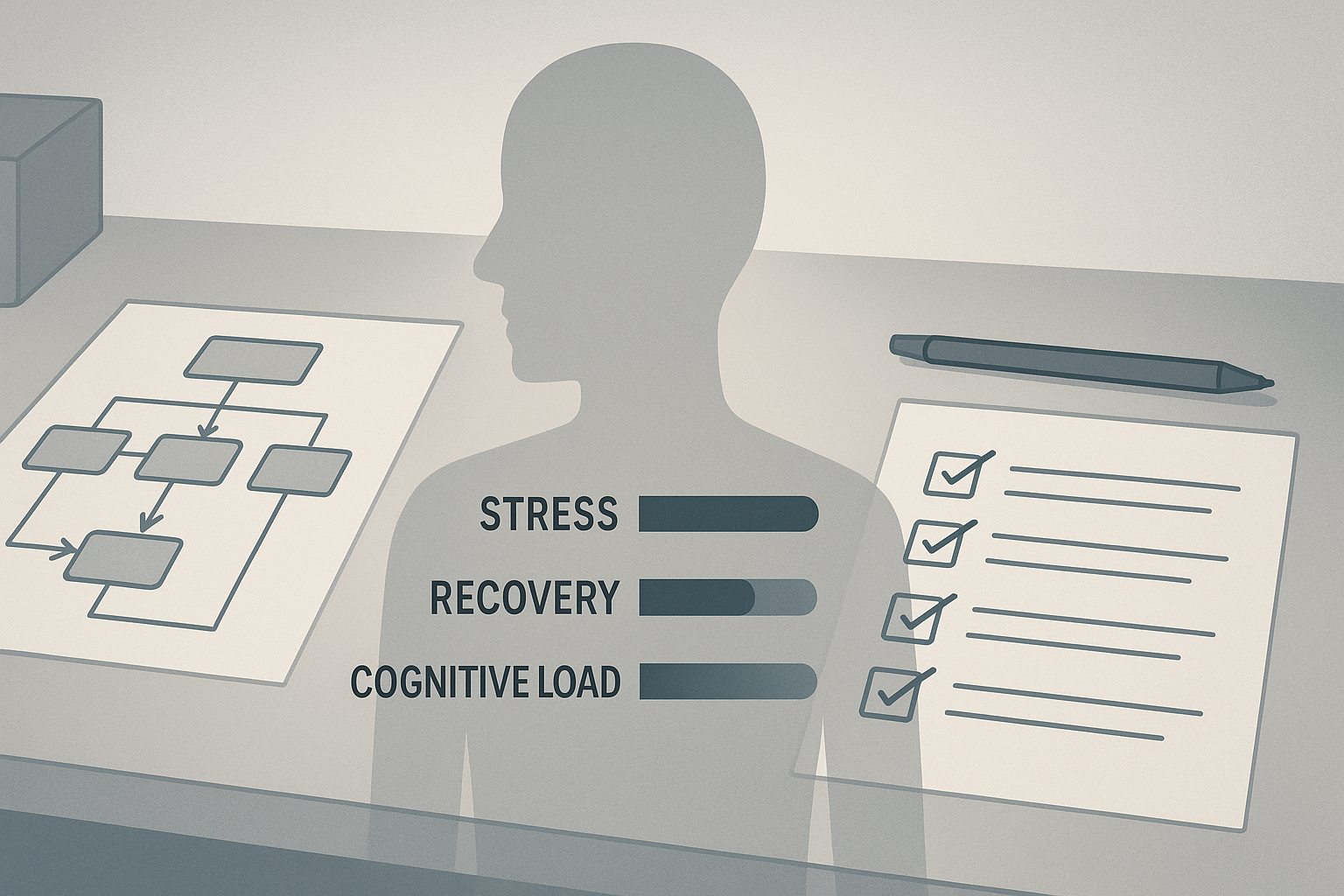
This test doesn’t measure “how cooperative you are.” It maps three physiological-behavioral axes that, in practice, determine your ability to adopt new procedures without losing clarity or health:
- Stress load: how much change triggers an alert response and internal pressure.
- Recovery debt: how much you’re operating at a deficit (sleep, breaks, decompression), reducing resilience and flexibility.
- Cognitive overload: how much “mental RAM” is taken up by rules, exceptions, tools, and micro-decisions.
What you’ll get (in practical terms)
By the end, you’ll have an interpretation focused on:
- Hidden patterns: early signs of unintentional resistance (e.g., avoidance, over-control, “rational” procrastination).
- Imbalances: when the issue isn’t the procedure itself, but the relationship between required load and available recovery.
- Operational autonomy: areas you can act on to reduce friction and increase reliability, without relying on willpower.
How to answer (to improve accuracy)
- Answer with the last 4–6 weeks in mind, or the most recent relevant procedural change.
- If you work across multiple contexts, choose the one with the greatest impact (more consequences, more external control, more complexity).
- Don’t aim for narrative consistency: this test is designed to capture functional contradictions (e.g., high compliance but high internal cost).
What this test is not
- It is not a clinical diagnosis or a performance evaluation.
- It is not a “label-based” personality test.
- It does not assume the procedure is right or wrong: it measures its impact on you and the mechanisms you use to handle it.
Interpretation: three axes that are often confused
1) Stress load (stress-load-axis)
A high load can show up as constant urgency, irritability, hypervigilance about mistakes, or a need for control. In these cases, resistance may be a form of protection (reducing perceived risk), not a rejection of change.
2) Recovery debt (recovery-debt-axis)
If recovery is insufficient, even simple procedures feel “heavy.” A typical sign is reduced tolerance for friction: small ambiguities trigger disproportionate reactions. Here, the intervention isn’t “getting motivated,” but restoring margin.
3) Cognitive overload (cognitive-overload-axis)
As rules, exceptions, tools, and steps increase, so does the number of micro-decisions. Overload leads to trivial mistakes, slowness, blocks, and a need for reassurance. It’s often mistaken for low competence, but it’s a problem of work architecture and information load.
Related deep dives
If you want to broaden your interpretation of your profile, you can compare the results with:
- Work stress assessment (to distinguish external pressure from self-imposed pressure).
- Recovery and sleep quality (to understand whether you’re operating in debt).