Why this test exists
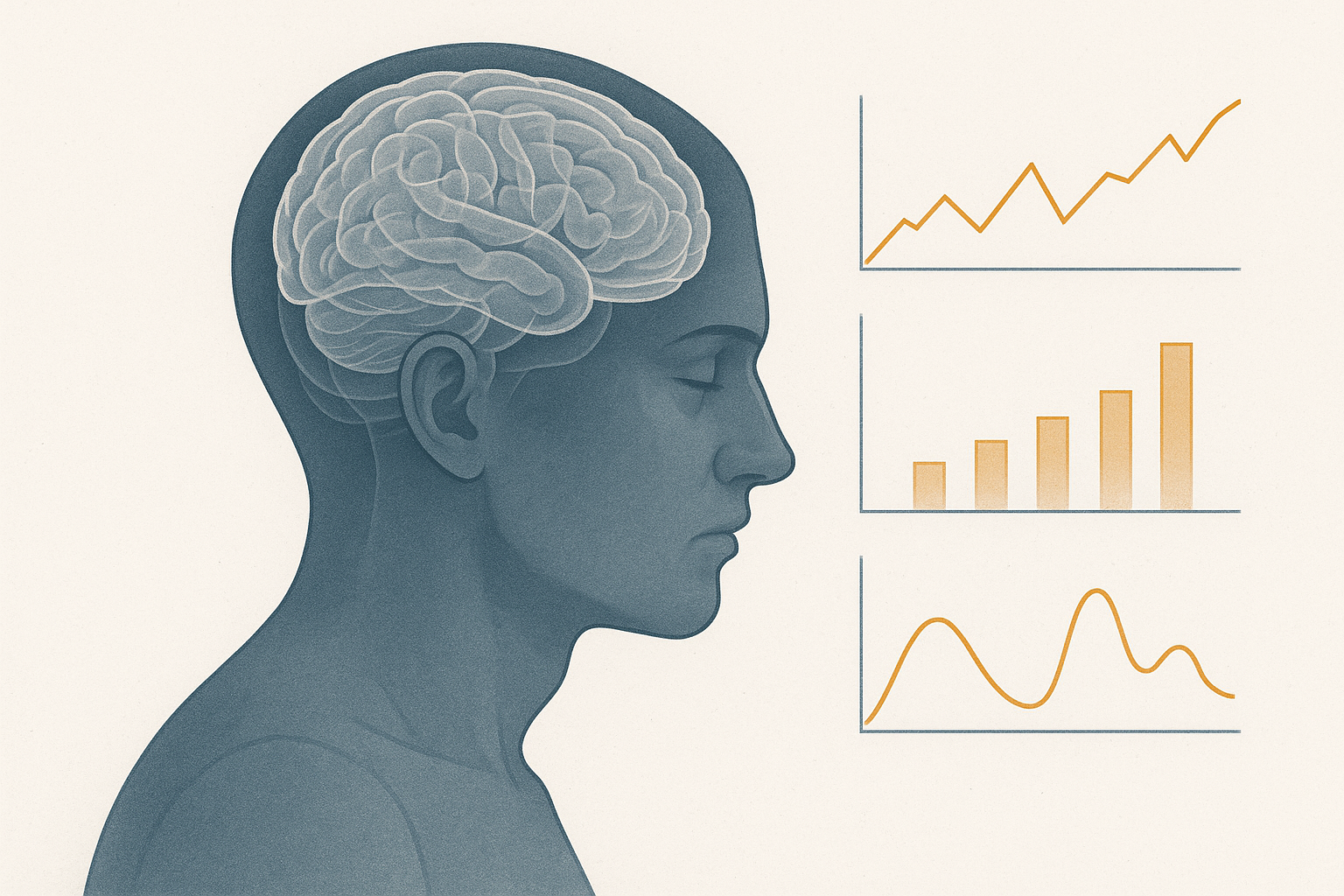
Procrastination isn’t always a “lack of willpower.” In many cases, it’s a signal of overload: your cognitive system can no longer sustain the cost of starting, choosing, and maintaining attention. When your mind is full, putting things off becomes a load-reduction strategy—often automatic.
This test doesn’t measure your “discipline.” It maps three dimensions that, together, explain much of overload-driven procrastination:
- Stress load: how much pressure (external and internal) you’re carrying.
- Recovery debt: how far behind your system is on sleep, breaks, decompression, and restoration.
- Cognitive overload: how much complexity, fragmentation, and attention-switching you’re managing.
What you’ll get
At the end, you’ll receive a profile with:
- an estimate across the three axes (stress load, recovery debt, cognitive overload);
- indicators of hidden patterns (e.g., selective delay, difficult starts, choice paralysis, escape into micro-activities);
- watch points for possible physiological and behavioral imbalances (e.g., insufficient sleep, hyperarousal, rumination, digital fragmentation);
- an interpretation oriented toward autonomy: what truly reduces the cost of starting—and what increases it.
How to answer (to get useful data)
- Answer with the last 14 days in mind, not “what you’re like in general.”
- Think in terms of typical days, not exceptions.
- If you’re torn between two options, choose the one that reflects your most frequent behavior.
Methodological note: overload-driven procrastination often shows up as smart avoidance: the brain reduces exposure to high-cost tasks (decisions, ambiguity, risk of error, conflict). This test looks for those costs—not “laziness.”
Typical (non-diagnostic) signs of overload-driven procrastination
- Difficult starts even on important tasks, with improvement only under urgency.
- Selective delay: certain categories of tasks (ambiguous, relational, high-risk) are consistently avoided.
- Escape into micro-activities (tidying up, email, “just a second”) that brings relief but doesn’t reduce the real load.
- Decision fatigue: too many small choices drain your ability to make the big ones.
- Insufficient recovery: sleep and breaks don’t offset the accumulated activation.
When to interpret with caution
If you’re experiencing severe insomnia, pronounced depressive symptoms, panic attacks, problematic substance use, or a rapid decline in day-to-day functioning, this test can offer initial orientation but does not replace a clinical assessment. In those cases, the priority is safety and stabilization.
Internal deep dives (optional)
If you’d like to connect your results to other patterns, you can explore: Stress–recovery system map and Attentional fragmentation and switching.