Nervous System & Recovery

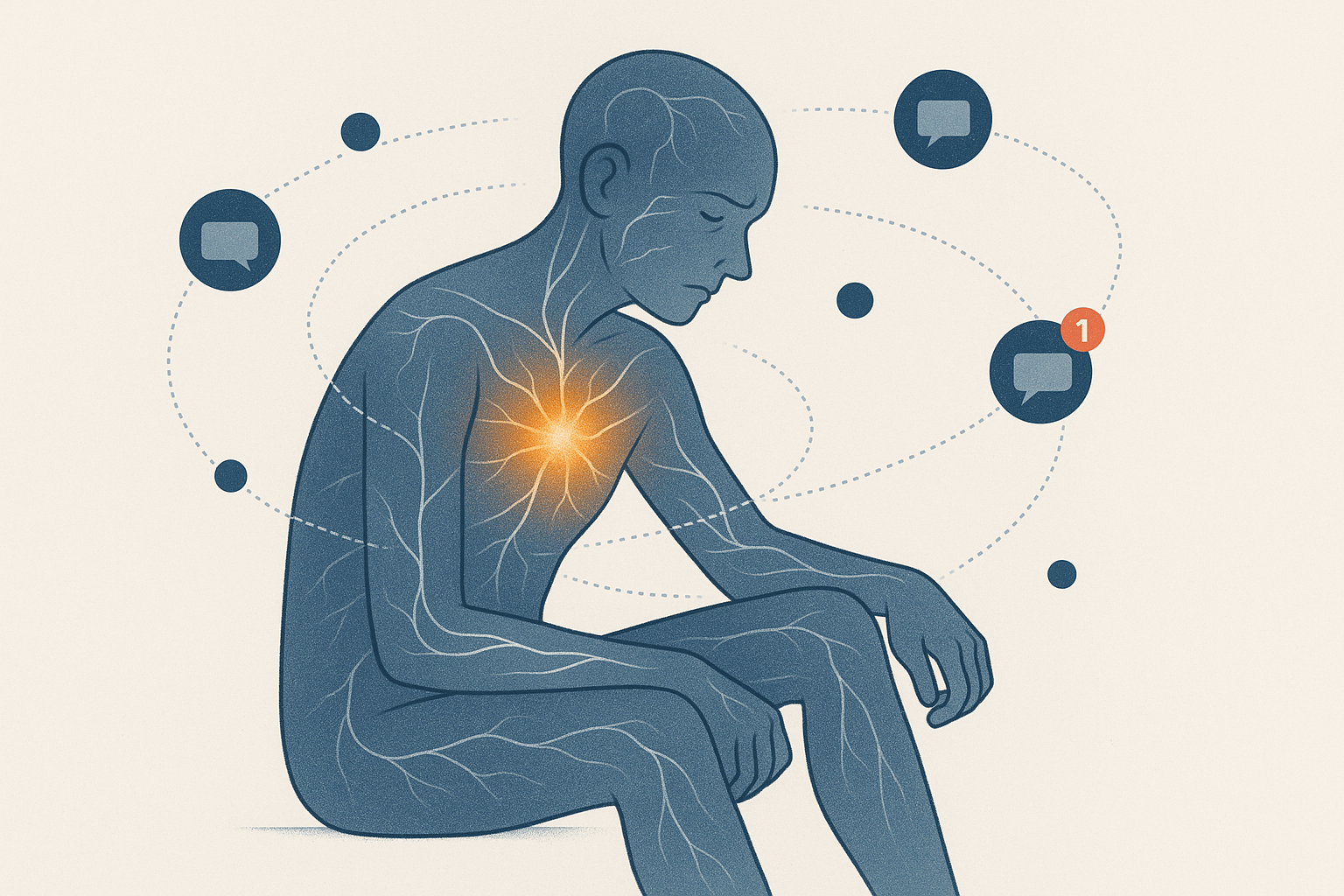
Internal agitation for no apparent reason: a map of stress, recovery, and cognitive overload

15 questions 8 min63 people have taken this test
Internal agitation for no apparent reason: a map of stress, recovery, and cognitive overload

Assess internal agitation with no obvious cause: stress load, recovery debt, and cognitive overload. A structured test to recognize physiological and behavioral patterns.

Sign up or log in to take the test

Registration is required to start any test.

What this test analyzes

Index of overall pressure being carried (external demands, self-imposed standards, hypervigilance, urgency). A high value suggests that activation is driven by demands and perceived threats, even subtle ones.
Index of the gap between exertion and recovery (sleep, genuine breaks, decompression, energy fluctuations). A high value suggests the nervous system isn’t returning to baseline.
Index of active mental load (task switching, open loops, mental urgency, difficulty switching off). A high value suggests the mind remains activated even in the absence of obvious external events.

Why you might feel agitated “for no reason”

Internal agitation without an immediately identifiable cause is often a sign of nervous system hyperactivation. It doesn’t necessarily mean there’s a “psychological” problem in the everyday sense of the word: it can arise when your body and mind are carrying an overall load that exceeds your capacity to recover.

This test doesn’t aim to give you a quick label. It helps you distinguish three mechanisms that—often in combination—create that background sense of tension, restlessness, alertness, or urgency that isn’t justified by the situation:

  1. Stress load: how much pressure (external and internal) you’re carrying.
  2. Recovery debt: how much your actual recovery falls short of what you’re expending.
  3. Cognitive overload: how much “operational rumination” you’re keeping active (open loops, micro-decisions, control, anticipation).

What the test measures (and what it doesn’t)

It measures

  • hyperarousal patterns (high activation) and consistent bodily signals;
  • signs of incomplete recovery (sleep, breaks, decompression, energy variability);
  • signs of cognitive overload (fragmented attention, mental urgency, difficulty “closing” loops).

It does not measure

  • clinical diagnoses (anxiety, mood disorders, etc.);
  • specific medical causes (e.g., thyroid issues, anemia, medication effects). If symptoms are intense, new, or worsening, it makes sense to discuss them with a healthcare professional.

How to answer to get a useful profile

  • Think about the last 2 weeks, not your “ideal typical day.”
  • Answer based on frequency and impact, not on how much you think you “should” be able to handle.
  • If you’re torn between two options, choose the one that best describes what happens when you’re under pressure.

Interpretation: three axes, one map

Your final result is a three-axis map. There’s no “perfect score”: the goal is to understand where the agitation is coming from and what keeps it going.

  • High stress load without recovery debt may indicate an intense phase that you’re still compensating for.
  • High recovery debt with moderate stress suggests the issue isn’t only “how much you do,” but how you recover.
  • High cognitive overload can sustain activation even in the absence of obvious stressful events.

If you’d like to go deeper, you can compare this profile with your Nervous System & Recovery profile or with the test on sleep quality and recovery.

Warning signs (when not to put it off)

Consider a clinical consultation if the agitation is accompanied by: chest pain, fainting, persistent palpitations, unintentional weight loss, prolonged severe insomnia, frequent panic attacks, increasing use of alcohol/substances to “switch off” activation, or if it significantly interferes with work and relationships.

Frequently asked questions

Is it possible to feel agitated without being “anxious”?
Yes. Agitation can be primarily physiological (hyperarousal, insufficient sleep, stimulants, inflammation, pain, circadian rhythm dysregulation) or cognitive (overcontrol, anticipation, multitasking). Anxiety is one possible interpretive frame, but it isn’t the only one.
What’s the difference between stress load and recovery debt?
Stress load describes how much pressure you’re carrying (demands, responsibilities, conflict, self-imposed expectations). Recovery debt describes how little you’re restoring compared to what you’re spending (sleep, real breaks, decompression, rhythms). You can have high stress with adequate recovery, or moderate stress with insufficient recovery.
Why does agitation increase precisely when I finally “have nothing to do”?
When activation is chronically high, the nervous system can stay in a state of alert even without stimuli. Also, if cognitive overload is high, “emptiness” reduces distractions and makes bodily signals and unfinished thoughts more noticeable.
Can caffeine and stimulants mimic internal agitation?
Yes. Caffeine, nicotine, some pre-workout supplements, and decongestants can increase heart rate, tension, and restlessness. The point isn’t to demonize them, but to observe dose, timing, individual sensitivity, and interaction with sleep and stress.
If my cognitive overload score is high, does it mean I think “too much”?
Not necessarily. It means a significant share of mental resources is tied up in open loops: micro-decisions, monitoring, anticipation, operational rumination, frequent switching. It’s an issue of load management and closing loops, not intelligence or willpower.
How reliable is a self-analysis test for something so subjective?
It’s reliable as a mapping tool: it makes recurring patterns and relationships between signals (stress–recovery–cognition) visible. It doesn’t replace a clinical assessment, but it can improve the quality of observations and practical decisions.
What can I do right away if I feel agitated while taking the test?
Reduce the intensity of the stimulus: take a 2–3 minute pause, breathe slowly (exhale longer than you inhale), drink water, get natural light if possible. Then resume. The goal is to observe, not to force.

Recommended tests

All tests