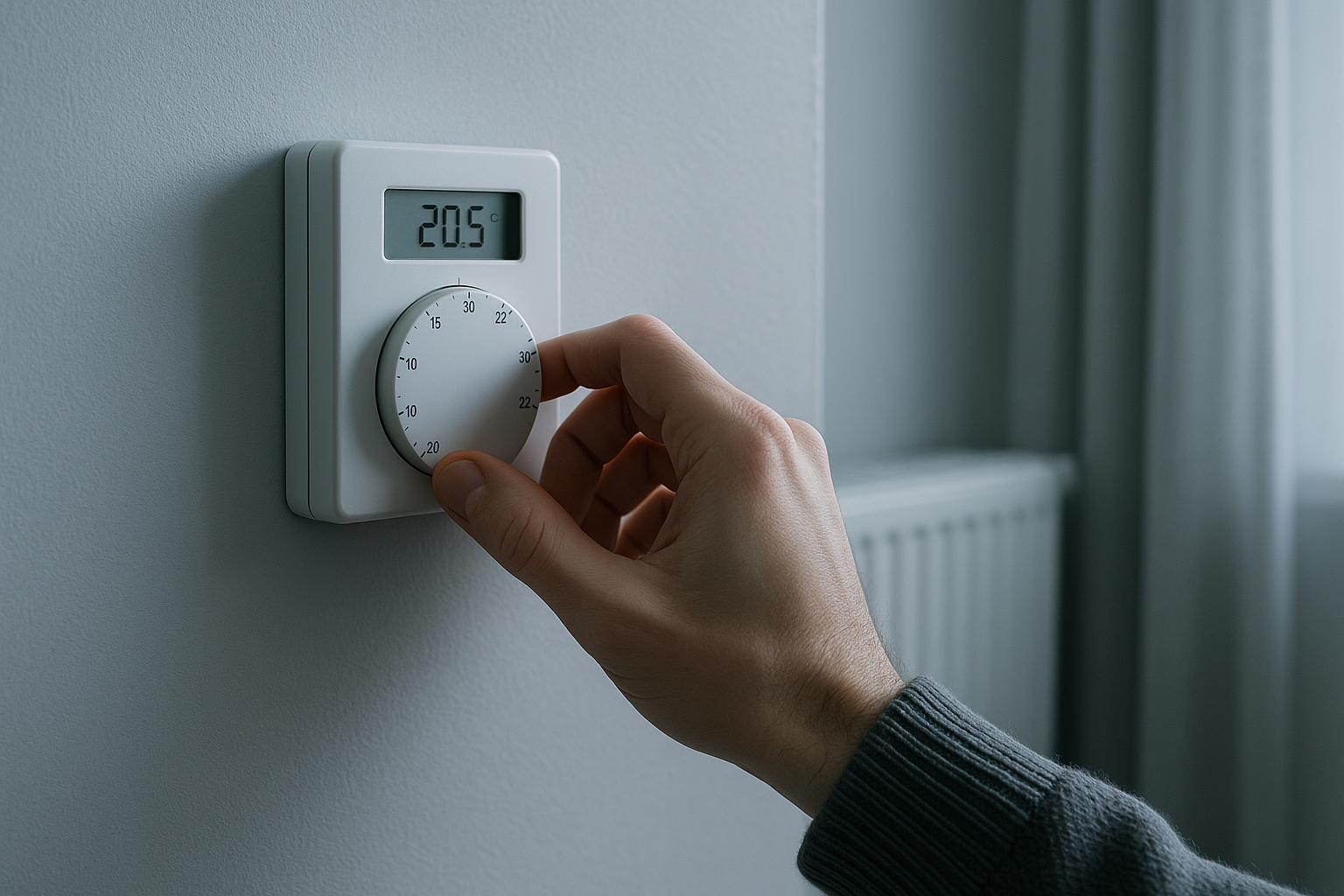
Home Energy Saving

Test: Inefficient heating management (patterns, waste, and decision load)

14 questions 8 min87 people have taken this test
Test: Inefficient heating management (patterns, waste, and decision load)

Assess whether you’re managing your heating inefficiently: habits, settings, comfort, heat loss, and cognitive load. Results on operational stress, recovery debt, and decision overload.

Sign up or log in to take the test

Registration is required to start any test.

What this test analyzes

Operational stress load
Estimates the extent to which heating management creates urgency, conflict, reactivity, and a sense of unstable control.
Recovery debt
Estimates how thermal comfort affects sleep, recovery, and self-regulation capacity (i.e., making more impulsive choices when you’re tired).
Cognitive overload
Estimates how much attention and how many micro-decisions the system demands: repeated checks, trial and error, unclear rules, fragmentation.

Why this test exists

Home heating management rarely fails because of a “lack of willpower.” More often, it breaks down due to invisible interactions between habits, building constraints, control quality, comfort expectations, and daily micro-decisions. The typical result is a system that consumes more than necessary and, paradoxically, does not deliver stable comfort.

This test is not a quick-tips quiz. It’s a self-assessment tool designed to identify behavioral and physiological patterns (operational stress, recovery debt, cognitive overload) that often accompany inefficient management: constant adjustments, family conflicts, the feeling of “not being able to make it work,” sleep disrupted by cold/heat, and decisions made while fatigued.

What it measures (and what it doesn’t)

Measures

  • Control patterns: how stable vs. reactive your management is (on/off, up/down, “heat spikes”).
  • Feedback quality: whether you make decisions based on data (temperature, time bands, zones) or on momentary sensations.
  • Heat-loss and friction factors: drafts, heating unused rooms, blocked radiators, habits that undermine efficiency.
  • Mental load: how much cognitive energy you spend “managing” heat at home.

Doesn’t measure

  • The property’s actual energy rating or the system’s real performance (you need technical data and an on-site inspection).
  • A system diagnosis. If you suspect faults or risks, you need a qualified technician.

How to answer to get a useful profile

  1. Answer with the last 3–4 weeks in mind, not “how it should be.”
  2. If you live with other people, consider how things are actually managed: compromises, conflicts, exceptions.
  3. If you’re torn between two options, choose the one that reflects the most common frequency.

Interpretation: the three axes (human index)

The test produces three profiling axes. They are not moral labels: they describe loads and debts that influence choices.

  • axis_stress_load: operational stress linked to urgency, conflict, and a sense of unstable control (e.g., “it suddenly gets cold,” “we can’t agree on the thermostat”).
  • axis_recovery_debt: the extent to which comfort management interferes with recovery and physiology (sleep, awakenings, tension, fatigue that leads to impulsive choices).
  • axis_cognitive_overload: decision overload and fragmented attention (micro-adjustments, repeated checks, unclear rules).

Typical signs of inefficiency (not always obvious)

  • “Wavy” comfort: alternating warm/cold conditions throughout the day.
  • Reactive control: intervening only once discomfort is already high, instead of preventing it.
  • Unmanaged zones: heating rarely used spaces or, conversely, creating “cold rooms” that cool down the rest of the home.
  • Poor feedback: decisions based on momentary perceptions (which vary with stress, fatigue, and physical activity).
  • Environmental friction: drafts, curtains covering radiators, long and frequent airing-out, doors left open without a clear rationale.

Methodological note (for demanding users)

The questions are designed to surface inconsistencies between goals (savings/comfort) and actual behavior, and to estimate the likelihood of “correction cycles” (repeated adjustments) that increase consumption and mental load. You don’t need to know the technology—you need to describe accurately what happens.

Related deep dives

If you want to put the results in context with other aspects of household management, you can explore: Home efficiency checklist and Household mental load profile.
Frequently asked questions

Does this test tell me whether my system is “up to code” or whether I need to replace it?
No. The test analyzes management patterns and behavioral/environmental friction points. Regulatory compliance and system diagnosis require technical checks (maintenance, efficiency, safety, combustion, valves, circulation).
Why do you talk about stress and cognitive overload in an energy-related topic?
Because many inefficiencies don’t depend only on the system but on how people make decisions under pressure: micro-adjustments, conflicts, urgency, and fatigue increase variability in control and reduce feedback quality. This tends to worsen both consumption and comfort stability.
If I keep the house warmer, does the test automatically penalize me?
No. The test doesn’t judge your “right” temperature. It mainly evaluates stability, consistency, and control quality relative to your constraints. A higher temperature can be managed in a stable, predictable way (less inefficient) or in a reactive, oscillating way (more inefficient).
I don’t have smart thermostats or sensors: is it still worth doing?
Yes. A lot of waste comes from routines, airing out, room management, radiator obstructions, and decisions made “by feel.” The test is designed to work even without advanced technology.
How reliable are the results if there are multiple people in the household?
They’re often more useful, because friction and inconsistencies emerge (rules not shared, uncoordinated interventions). Answer by describing the real management: who decides, who intervenes, and how often settings are changed.
What does “recovery debt” mean in practice?
It’s an indicator of the physiological cost of managing comfort: disturbed sleep, waking up because of cold/heat, tension and fatigue that reduce the ability to plan. When the debt grows, impulsive decisions increase (e.g., turning the temperature way up to “catch up”), often inefficient.
Does the test replace reading consumption data or utility bills?
No, but it complements it. Bills tell you “how much” you consume; this test tries to explain “why” you might consume that way, highlighting patterns and friction points that don’t show up in the numbers.
What can I do if the result indicates high cognitive overload?
Generally, you need to reduce the number of daily decisions: a few clear rules, defined responsibilities (who sets what), a stable routine by time slots and rooms, and minimal reliable feedback (even just a thermometer in a key room). The goal is to reduce reactive adjustments.

Recommended tests

All tests