Assess how standby and invisible loads affect consumption, habits, and mental load. Identify patterns, recovery debt, and cognitive overload in household energy management.
Why this test exists
Standby power and so-called phantom loads aren’t just a utility-bill issue: they’re a signal of how you manage attention, routines, and decision friction in everyday life. In many homes, hidden consumption is the sum of micro-loads: power adapters left plugged in, devices idling, appliances kept “ready” for convenience. The result is often a household system that uses energy even when you’re trying to restore yours.
This test doesn’t ask you to “be more disciplined.” It helps you identify:
- Hidden patterns (where energy leaks away without you noticing);
- Imbalances between load (how many sources of consumption and decisions) and recovery (how much the household system is designed to reduce effort);
- Cognitive overload (how much mental management it takes to “do the right thing”).
What it measures (operationally)
1) Energy stress load (axis_stress_load)
How much your home is exposed to invisible consumption and repeated choices: lots of devices, lots of exceptions, lots of “little things” that stay on.
2) Recovery debt (axis_recovery_debt)
How much you lack a system that helps you recover automatically: stable routines, accessible outlets/power strips, basic automation, simple measurement. A high debt means that even when you want to improve, it costs you too much.
3) Cognitive overload (axis_cognitive_overload)
How much mental energy you spend remembering what to switch off, when, and why. If control depends on memory and willpower, overload tends to grow.
How to answer (to get a useful profile)
- Answer based on the last 2 weeks, not how you’d like to be.
- If you live with other people, consider the true average of household habits.
- Don’t look for the “right” answer: what matters here is the stability of behavior, not intention.
What you’ll get at the end
- A reading of the three axes (load, recovery, overload) with typical friction points.
- Guidance on which actions offer the best impact-to-effort ratio for your profile.
- A distinction between infrastructure problems (outlets, power strips, placement) and process problems (routines, shared rules, delegation).
Method note (transparency)
This test does not estimate kWh precisely: it measures the likelihood of hidden consumption and the management effort involved. If you want instrument-based measurement, a power meter or a smart plug with reporting can validate the hypotheses that emerge.
Related deep dives: Guide to phantom loads and Household energy-saving checklist.
Frequently asked questions
What is meant by “hidden consumption” or “phantom loads”?
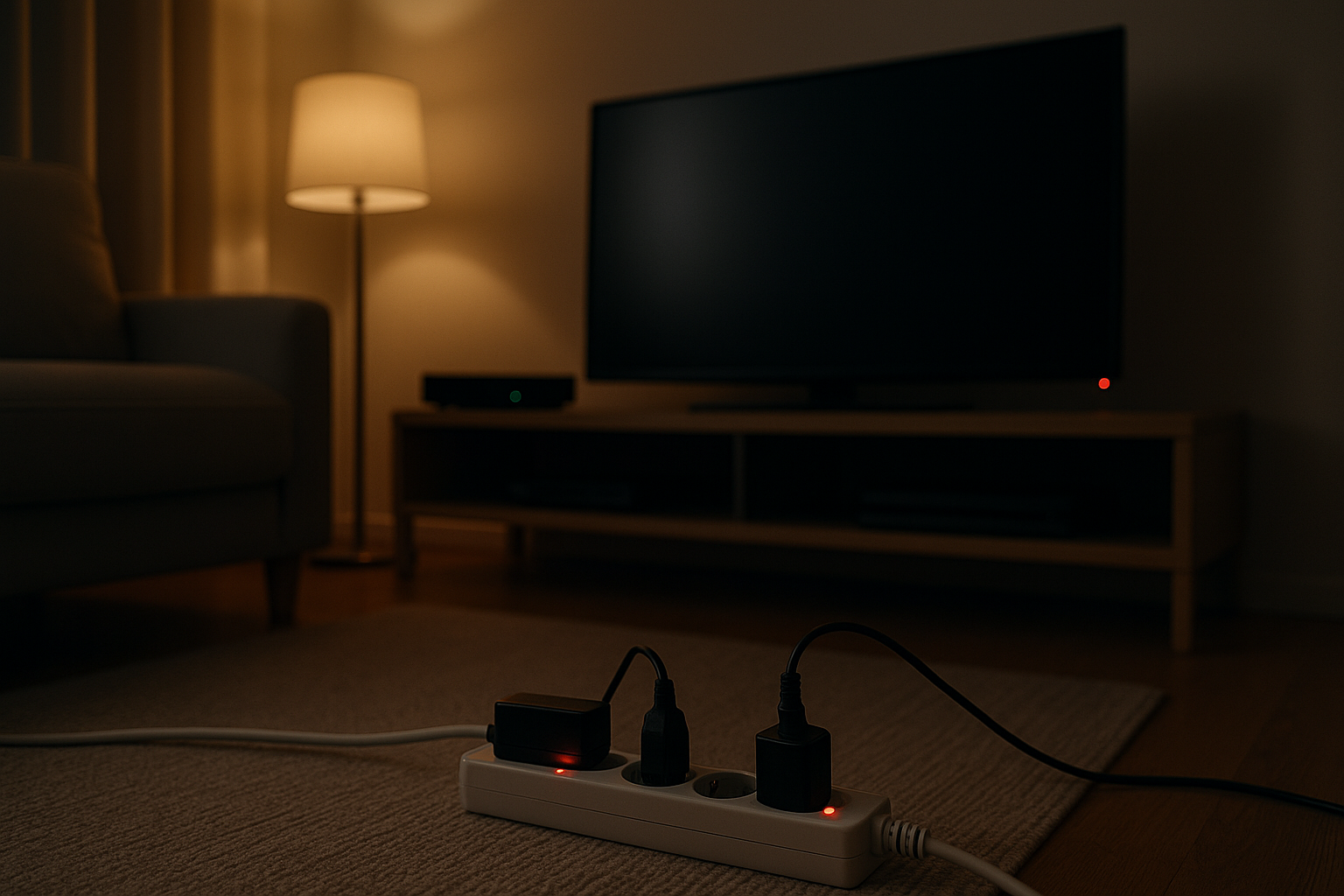
It’s the energy absorbed by devices and power supplies when you’re not actively using them: standby mode, plugged-in transformers, appliances waiting for a command, status lights, network modules. It’s not “mysterious”: it’s often small per item, but significant in total.
Does standby really affect the bill, or is it negligible?
It depends on the number of devices, their generation, and how long they stay in standby. In a home with many appliances (TV, set-top box, console, printers, router, smart speaker, chargers), the cumulative effect can become noticeable. The test helps you understand whether your home setup is prone to this kind of buildup.
Is turning everything off every evening the best solution?
Not always. If the strategy requires remembering and lots of manual actions, it tends to fail over time. In many cases it’s more effective to reduce the number of decisions: group loads on accessible power strips, define a few stable rules, automate what’s repetitive.
Should the router and modem be turned off at night?
It depends on your needs (remote work, home automation, updates, security, VoIP calls). Turning them off can reduce consumption, but it can introduce indirect costs (service interruptions, reboots, loss of automations). The point is to evaluate the trade-off and, if needed, use timers or consistent schedules.
Do smart plugs solve the problem or add complexity?
They can reduce consumption and, above all, mental load if used wisely (a few high-impact points, simple automations). If they multiply exceptions and apps, they can increase cognitive overload. The test highlights which of the two scenarios is more likely for you.
Why does the test talk about stress and recovery in a “technical” topic like household energy?
Because invisible consumption is often the result of a home system that requires continuous attention. When management depends on vigilance, the likelihood of mistakes and giving up increases. Stress, recovery, and overload are behavioral variables that determine whether a change is sustainable.
Does this test replace an energy assessment or a professional audit?
No. It’s a tool for behavioral self-analysis and habit design. However, it can help you decide where to measure, what to monitor, and which interventions make sense before investing in more expensive solutions.