Why this test exists
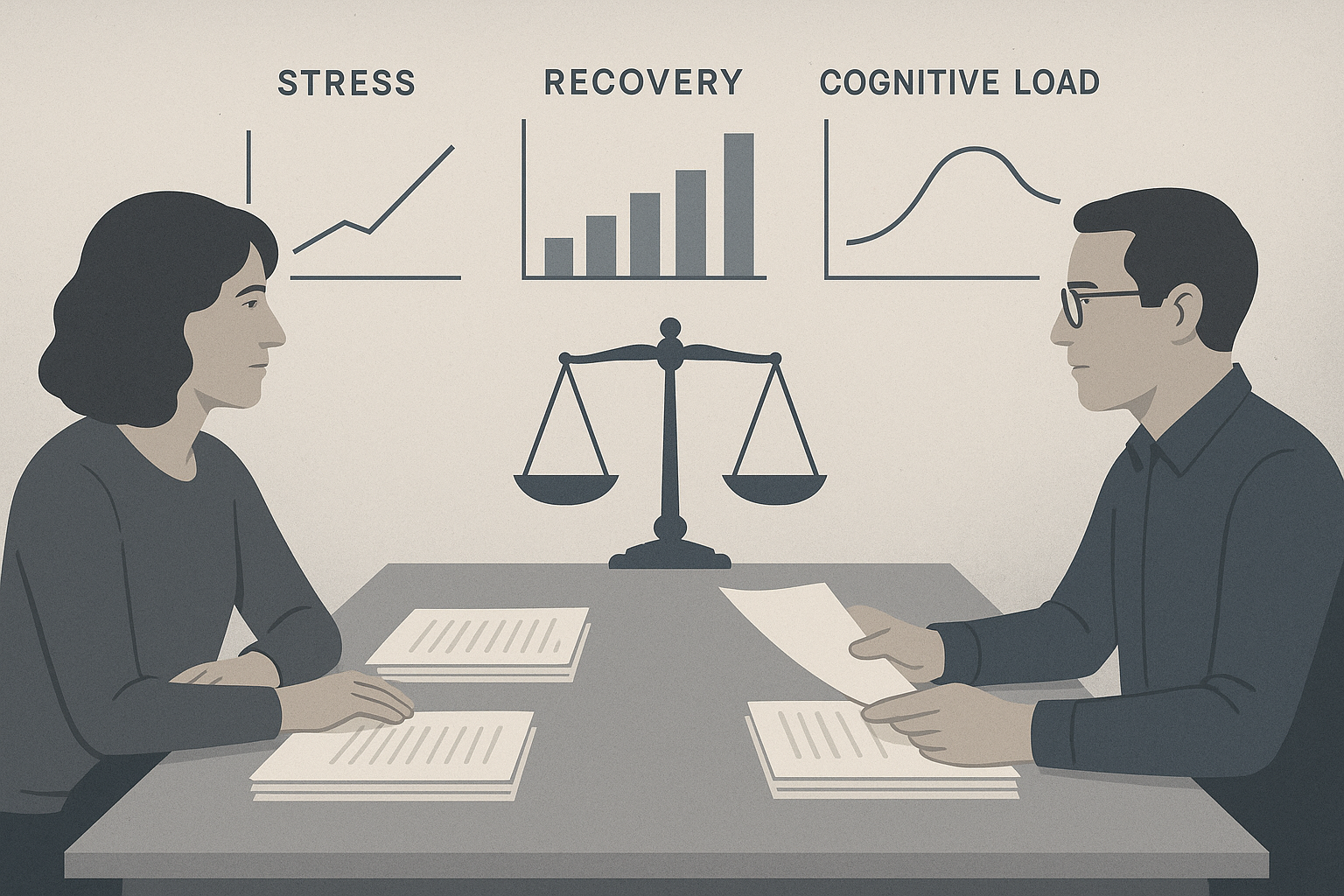
Many people don’t “choose the wrong goals”: they choose the wrong decision-making system for turning them into repeated choices. Consistency doesn’t depend only on willpower or discipline. It depends on three measurable factors that shape judgment:
- Stress load: when the body is on high alert, the brain prioritizes urgency and immediate risk reduction.
- Recovery debt: when recovery is insufficient, decision quality drops even if you “feel functional.”
- Cognitive overload: too many variables, too many options, or too many micro-decisions reduce your ability to stay on a steady course.
This test doesn’t assess “how good you are.” It maps patterns: where you lose alignment, under what conditions, and with which early signals.
What it measures (and what it doesn’t)
It measures
- Decision alignment: how closely your real choices follow your stated goals and stable criteria.
- Urgency drift: how much the immediate displaces the important.
- Process quality: clarity of criteria, trade-off management, and post-decision review.
- Three physiological–cognitive axes: stress load, recovery debt, and cognitive overload.
It doesn’t measure
- Intelligence, personal worth, or “potential.”
- Clinical diagnoses. If signs of intense or persistent distress emerge, consider speaking with a professional.
How to answer to get a useful profile
- Answer with the last 2–4 weeks in mind, not a single “good” or “bad” day.
- If you’re torn between two options, choose the more frequent one.
- Don’t try to create a coherent narrative: the test is designed to detect informational inconsistencies (often the most useful data).
Interpretation: what “consistent” means in practice
A decision is consistent with your goals when it:
- uses explicit criteria (even simple ones), not just in-the-moment feelings;
- includes a conscious trade-off (what you’re sacrificing and why);
- reduces the need for later “repairs” (costly corrections, apologies, forced catch-up);
- is repeatable: in similar conditions, you’d make a similar decision.
As stress, recovery debt, and cognitive overload increase, consistency tends to degrade in three common ways: impulsivity (I choose just to be done with it), avoidance (I postpone to avoid choosing), and over-analysis (I analyze so I don’t lose control).
Useful links (optional)
If you want to go deeper after the test:
Methodological note
The questions combine decision-process indicators (criteria, review, urgency management) with state indicators (stress, recovery, cognitive load). The goal is to distinguish between:
- structural inconsistency (missing criteria and operational priorities),
- state-based inconsistency (the process exists, but collapses under load),
- context-driven inconsistency (too many demands/roles make it impossible to maintain a single course).