Performance & Productivity
Effective work time management: stress, recovery, and cognitive overload
Assess how you manage your work time: stress load, recovery debt, and cognitive overload. Identify hidden patterns and practical levers to improve autonomy and the quality of your attention.
Why take a time management test (no shortcuts)
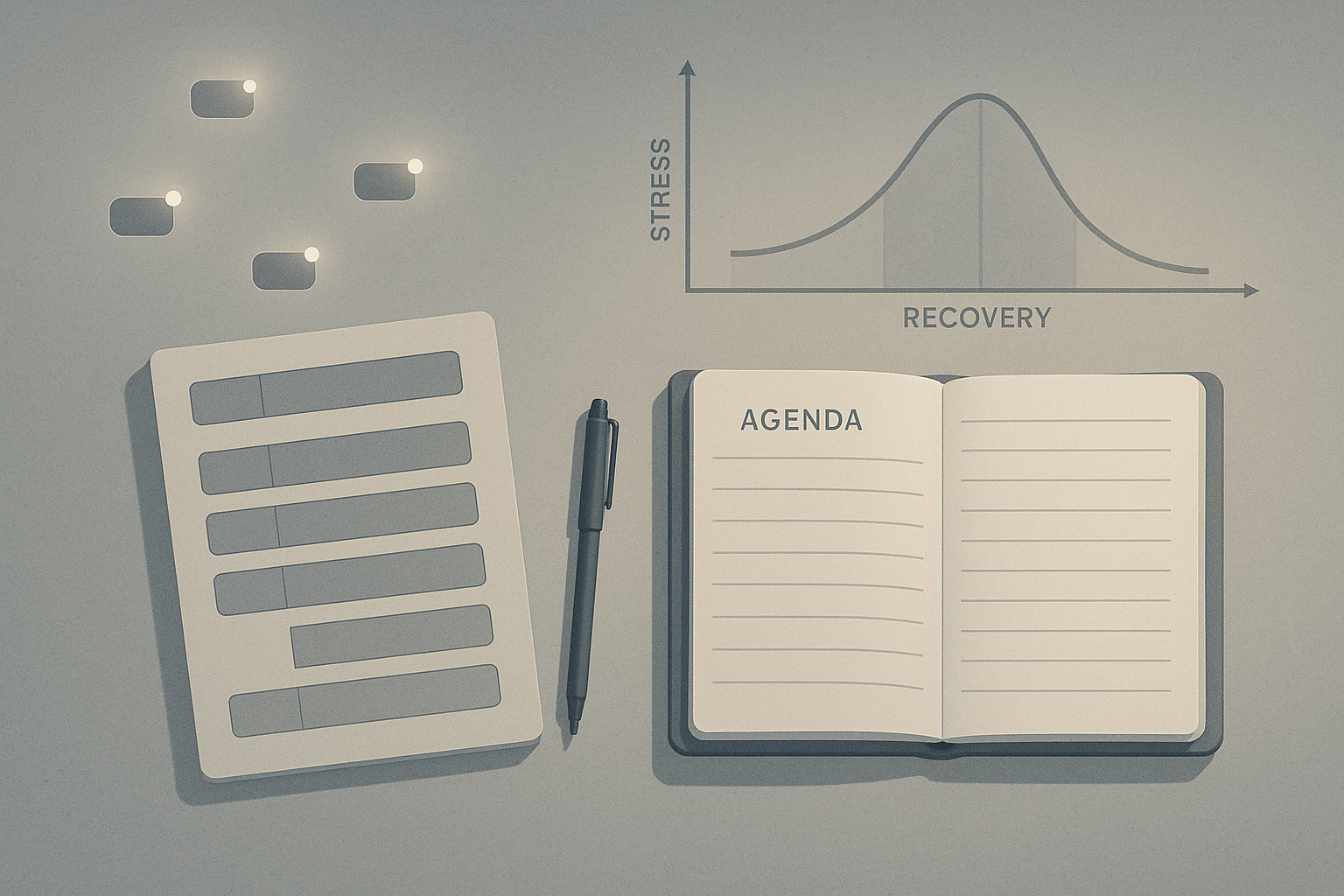
Managing your time at work isn’t just about your calendar. It’s a bio-behavioral phenomenon: it depends on how your nervous system tolerates the load, how much recovery you build up (or lose), and how much cognitive complexity you’re trying to compress into a finite day.
This test doesn’t measure “how productive you are.” It measures how you’re producing: at what physiological cost, with what quality of attention, and with what risk of instability over the medium term.
What the test assesses
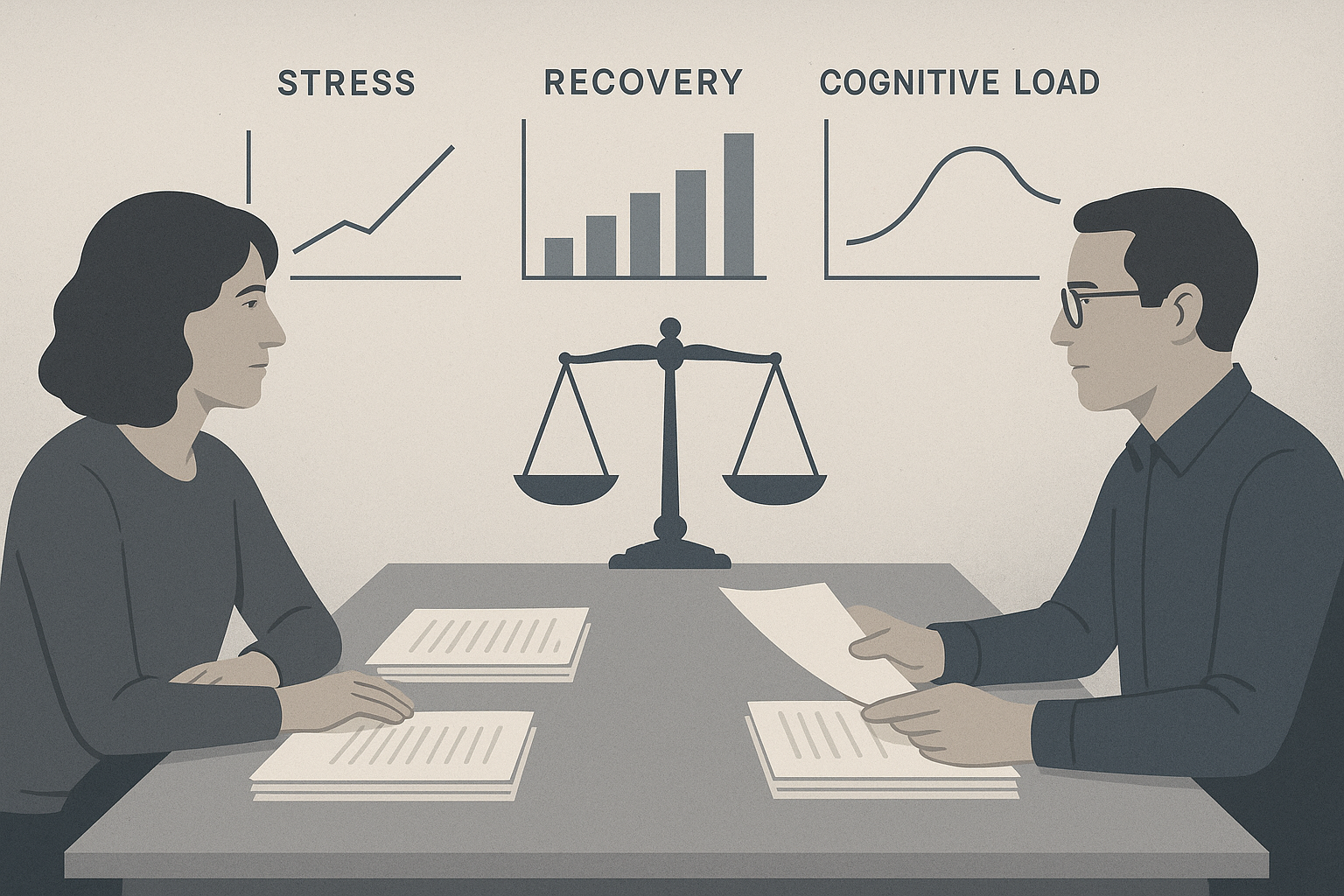
- Stress load (axis_stress_load): signs of sustained pressure, chronic urgency, reactivity, and work-related emotional friction.
- Recovery debt (axis_recovery_debt): the quality and quantity of genuine recovery (sleep, breaks, decompression), and how much your body “stays switched on” even outside working hours.
- Cognitive overload (axis_cognitive_overload): fragmented attention, constant task-switching, too many inputs and decisions, and difficulty sustaining deep work.
How to interpret the results (how to read them)
The three axes are not synonyms. Some typical profiles:
- High stress + Low recovery: risk of “holding up” in the short term and then dropping suddenly in the medium term; often you’re operating in emergency mode.
- High cognitive overload + Medium stress: you don’t always feel “anxious,” but your mind is saturated; errors, forgetfulness, and restart time increase.
- High stress + High overload: a combination that tends to generate reactivity, conflict, defensive procrastination, or overcontrol.
- Low recovery with unperceived stress: possible habituation to the load; the body pays the price even if the mind “normalizes” it.
The value of the test lies in highlighting repeated patterns (not isolated episodes) and in distinguishing between organizational problems and load-capacity problems.
Usage guidelines (for reliable answers)
- Answer with the last 2–3 weeks in mind, not your best or worst day.
- Factor in your real context: constraints, demands, interruptions, responsibilities.
- If you work shifts or go through peak periods, answer based on the most representative part of your cycle.
What you won’t find here
- Generic lists like “wake up earlier” or “use a to-do list.”
- Promises of total optimization: time isn’t created; it’s negotiated and protected.
- Blame: if the system is overloaded, the solution isn’t just “try harder.”
Related deep dives
If you want to connect this profile to other aspects of your self-regulation, you can explore:
Frequently asked questions
Does this test measure productivity?
It measures the drivers of sustainable productivity: stress load, recovery debt, and cognitive overload. Two people can “get a lot done” at different costs; this test makes that cost—and the patterns that create it—visible.
How reliable is it if I’ve just had an unusual week?
If the week was exceptional (deadlines, emergencies, illness), your answers will tend to overestimate stress and overload. In that case, answer with the last 2–3 weeks in mind, or retake the test during a more representative period.
What’s the difference between stress and cognitive overload?
Stress is mainly about pressure, urgency, reactivity, and physiological activation. Cognitive overload is about working-memory saturation, too many decisions, frequent switching, and difficulty maintaining mental continuity. They can coexist, but they’re not the same thing.
Is recovery debt only about sleep?
No. Sleep is central, but recovery also includes real breaks during work, post-work decompression, the quality of mental detachment, and the ability to “switch off” rumination. You can sleep enough and still have insufficient recovery if you remain constantly activated.
If my job is full of interruptions, does the test penalize me?
No. It’s not a penalty; it’s a snapshot of your real cognitive load. Interruptions aren’t a personal flaw, but a contextual factor that increases switching and restart time. The test helps distinguish what depends on you from what requires negotiation or workflow redesign.
Can I use the result to decide what to change right away?
Yes, but with judgment. A high score on an axis shows where to intervene first: if recovery debt is high, the priority is reducing activation and restoring breaks/sleep; if cognitive overload is high, the priority is reducing inputs and switching; if stress load is high, the priority is working on urgency, boundaries, and expectations.
How often does it make sense to retake the test?
Generally every 3–6 weeks, or after a concrete change (new role, new responsibilities, schedule changes, team reorganization). Repeating it too often increases noise and reduces your ability to see trends.
Can this test replace a clinical assessment?
No. It’s a self-analysis and awareness tool. If persistent signs of burnout, significant insomnia, marked anxiety, or functional decline emerge, it’s appropriate to consider speaking with a qualified professional.