Why measure the quality of coworker relationships (without reducing it to “getting along”)
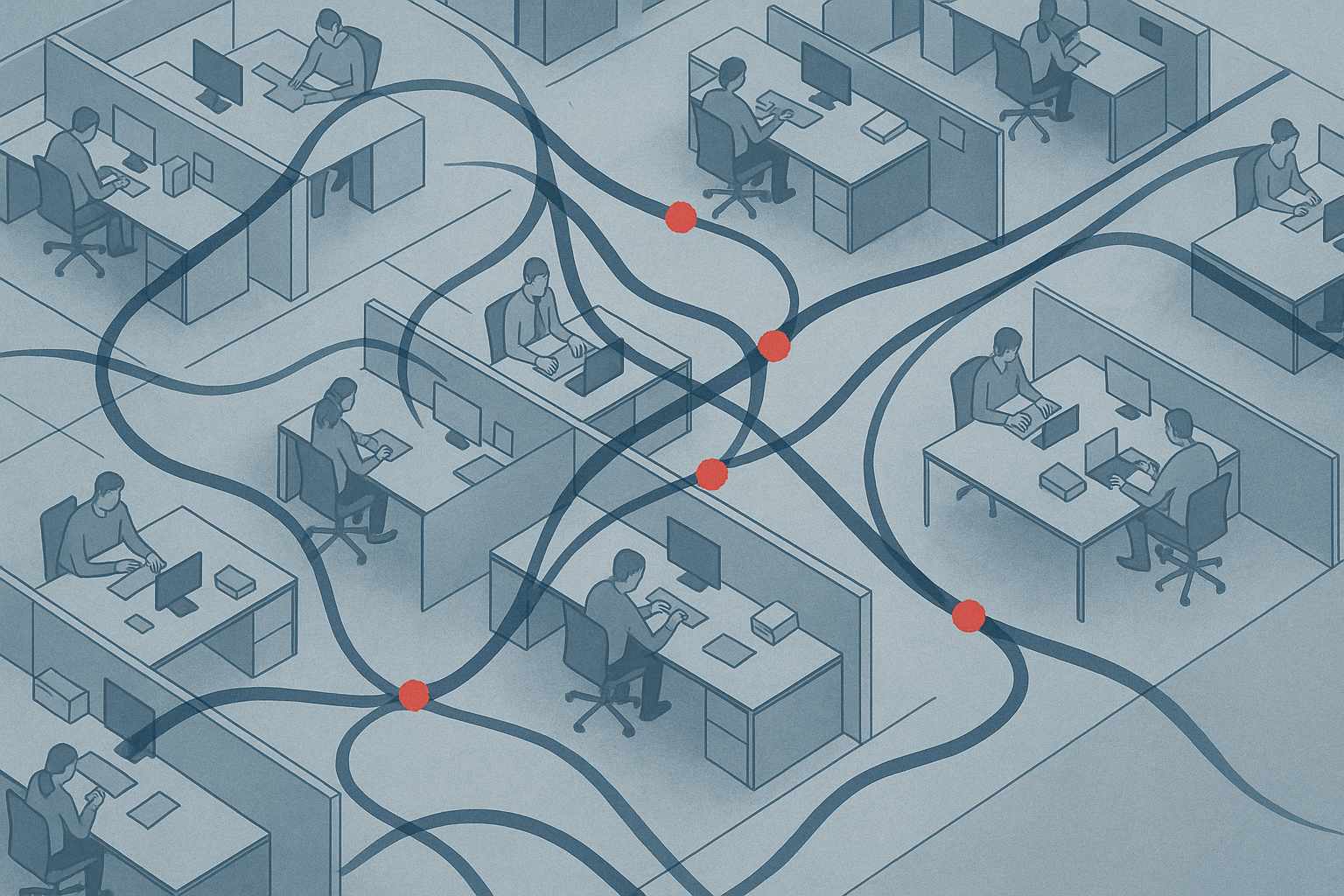
Coworker relationships aren’t a “soft” factor: they’re a system for exchanging information, trust, micro-decisions, and emotional regulation. When they work well, they reduce operational friction and cognitive costs. When they deteriorate, ambiguity, over-monitoring, avoidance, and rumination increase—with measurable effects on stress, recovery, and work quality.
This test doesn’t assess your “likeability” or your “ability to socialize.” Instead, it looks at recurring patterns that often remain invisible: how you manage boundaries, feedback, conflict, alliances, implicit requests, and emotional load. The goal is to increase operational awareness: understanding what’s happening, where recovery debt accumulates, and which conditions amplify cognitive overload.
What the test measures
- Functional relationship quality: clarity, reliability, reciprocity, coordination.
- Psychological safety: the ability to ask questions, admit mistakes, and disagree without retaliation.
- Friction index: micro-conflicts, passive-aggressiveness, triangulation, deliberate ambiguity.
- Relational load: how much mental/emotional energy it takes to “be part of the group.”
- Physiological and cognitive impact: signs of stress, insufficient recovery, attentional saturation.
How to answer (to get a useful profile)
- Answer with the last 4 weeks in mind, not a single episode.
- If you work across multiple teams, think about the one you interact with most.
- Don’t look for the “right” answer: what matters here is frequency and impact.
- If a question doesn’t apply, choose the closest option (or “Rarely”).
Interpretation: three axes that explain why relationships feel heavy
1) Stress Load (stress-load-axis)
Measures how much coworker dynamics increase activation, vigilance, and tension. It’s not “stress in general”: it’s relational-operational stress (e.g., excessive monitoring, fear of being misunderstood, latent conflicts).
2) Recovery Debt (recovery-debt-axis)
Measures whether the system is “paying interest”: insufficient recovery after socially dense days, difficulty switching off, disturbed sleep, rumination. High debt indicates that even small frictions become amplifiers.
3) Cognitive Overload (cognitive-overload-axis)
Measures how much mental bandwidth is absorbed by ambiguity, internal politics, multi-channel communication, implicit messages, and impression management. When it’s high, thinking quality worsens: more mistakes, more reactivity, less creativity.
What you’ll get at the end
- A concise profile across the three axes (stress, recovery, overload).
- Indicators of patterns (e.g., conflict avoidance, over-adaptation, over-control, strategic isolation).
- An overview of the conditions that worsen or improve relationships (context, channels, roles, boundaries).
If you’d like to explore further in a complementary way: {{internalLink:work-related-stress}} and {{internalLink:burnout-signs}}.
Method note and limitations
This is a self-assessment tool: it does not replace clinical evaluations or structured HR interventions. If risk signals emerge (e.g., intense anxiety, persistent insomnia, significant somatic symptoms), consider speaking with a qualified professional.