Why measure values clarity (and not just state your values)
Company values aren’t just text—they’re an operating system. When they’re clear, they reduce decision friction, make behaviors predictable, and stabilize trust. When they’re vague or contradictory, they increase individual interpretation, constant negotiation, and the likelihood of “invisible” conflicts.
This test doesn’t assess whether the values are “nice” or “inspiring.” It assesses whether they’re actionable: whether they guide real choices under pressure, whether they’re consistent across hierarchical levels, and whether they reduce (or increase) the psychophysiological load of day-to-day work.
What the test measures
- Semantic clarity: Are the values defined unambiguously? Are there examples and boundaries?
- Behavioral consistency: Do what the company rewards and tolerates align with the stated values?
- Decision translatability: Do the values help you choose when there are trade-offs (time vs. quality, growth vs. sustainability, autonomy vs. control)?
- Impact on load: Unclear values create micro-decisions, self-censorship, and social hypervigilance—leading to higher stress and cognitive fatigue.
How to answer (to get a useful result)
- Answer based on the last 6–8 weeks, not how it “should” be.
- If you work on a team, answer based on your actual context (direct manager, processes, incentives), not corporate communications.
- If you’re torn between two options, choose the one that describes what happens most often.
Interpretation: what a “high” or “low” score means
High clarity doesn’t mean the absence of conflict—it means conflicts are manageable because shared criteria exist. Low clarity often produces a specific effect: people spend energy figuring out “what you can say,” “what it’s smart to do,” and “what will be punished,” which increases stress and worsens recovery.
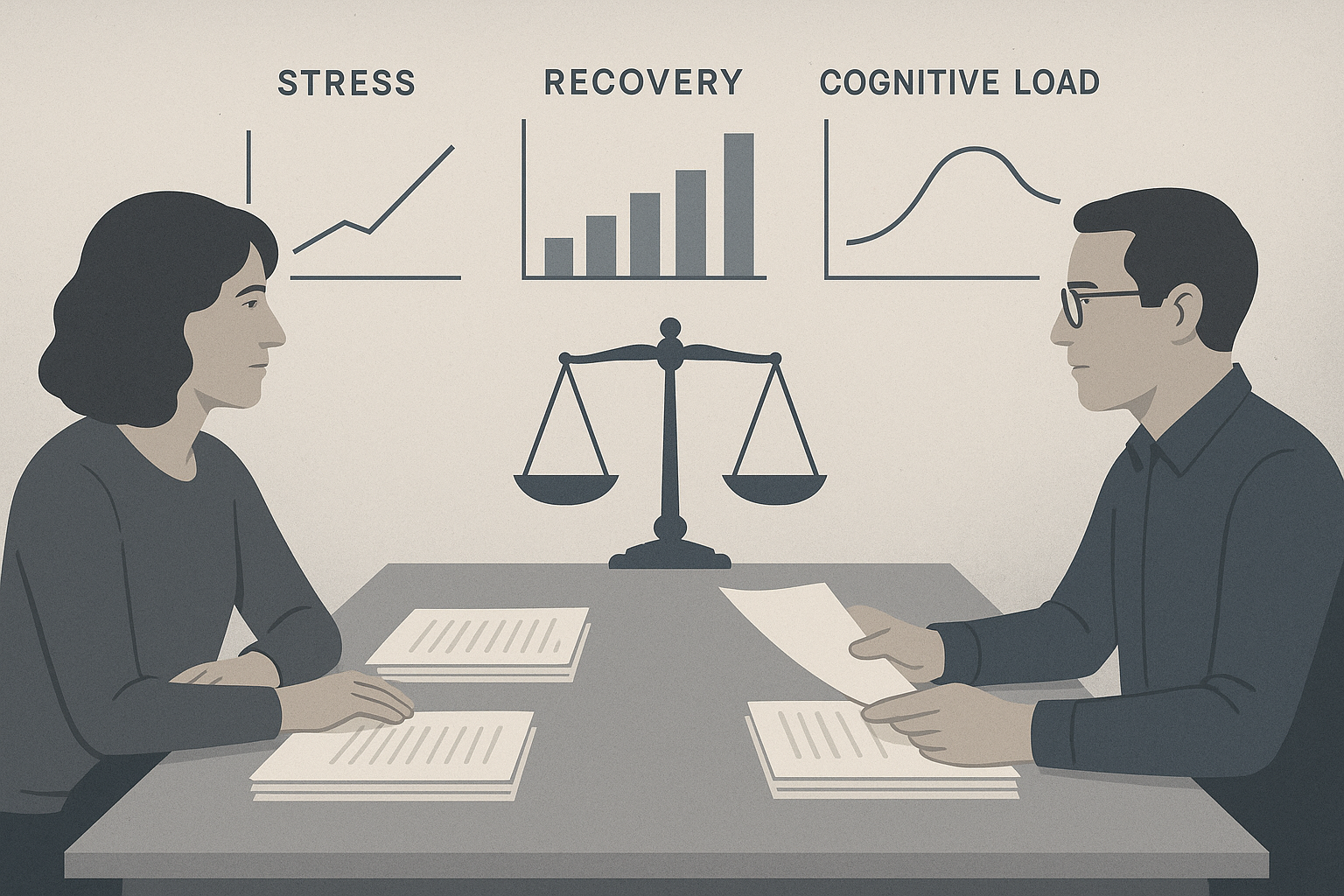
In the report, in addition to values clarity, you’ll find three psychophysiological axes that help interpret organizational impact:
- Stress Load: perceived pressure and sustained activation linked to ambiguity, inconsistencies, and social risk.
- Recovery Debt: how much the system is “paying later” (sleep disruption, irritability, a drop in motivation, cognitive sluggishness).
- Cognitive Overload: attentional and decision saturation caused by implicit rules, exceptions, and constant adjustments.
When this test is especially recommended
- During rapid growth, reorganizations, mergers, or leadership changes.
- When “the values exist,” but decisions still feel inconsistent.
- When subtle conflicts increase: passive-aggressiveness, silence, inconclusive meetings, late escalations.
- When people perform but burn out (high output, high cost).
Methodological note (transparency)
The questions are designed to detect behavioral indicators (what happens) and load indicators (what it costs). This is neither a clinical diagnosis nor a legal audit. It’s a self-assessment tool to identify areas of ambiguity and their effects on day-to-day functioning.