Why a test on developing and leveraging talent (without empty rhetoric)
Developing and leveraging talent isn’t “motivating” in some generic sense. It’s a series of repeated micro-decisions: what you notice, what you reinforce, what you ignore, how you allocate attention, autonomy, and risk. In many teams, the issue isn’t a lack of skills, but a failure to turn potential into sustainable performance.
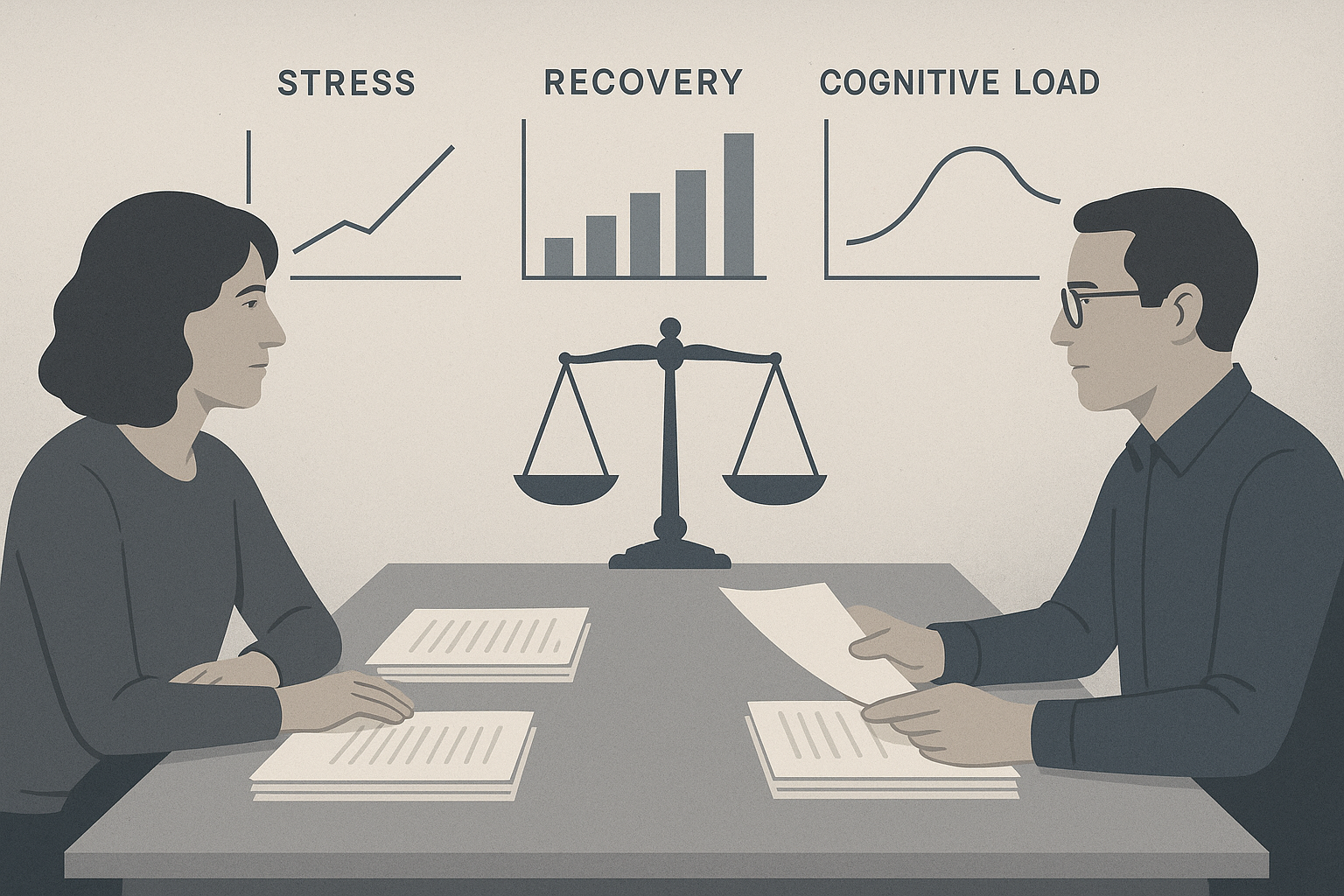
This test doesn’t measure how “good a leader” you are in the abstract. It looks at three often-invisible constraints that can distort your ability to bring out talent:
- Stress load: when pressure rises, we tend to narrow our field of perception and prioritize urgency over growth.
- Recovery debt: if you don’t recover enough, the quality of your attention and patience drops; reactivity and shortcuts increase.
- Cognitive overload: too many variables in your head lead to simplifications: quick labels on people, overly cautious delegation, delayed feedback.
What you’ll get
By the end, you’ll have a structured readout of:
- decision-making patterns that enable—or block—the emergence of talent;
- friction points between short-term goals and developing potential;
- imbalance indicators (stress/recovery/overload) that can distort how you evaluate people;
- operational levers (observation, feedback, delegation, context) to increase autonomy and work quality without “pushing harder.”
How to answer (for reliable results)
- Answer based on the last 4–6 weeks, not on how you’d like to be.
- If you manage multiple teams, choose the one you interact with most.
- If you’re torn between two options, choose the one that describes what happens more often.
Methodological note: the questions are designed to surface real trade-offs (time vs. development, control vs. autonomy, urgency vs. learning). There is no perfect profile—only configurations that are more or less sustainable.
What it means to “develop and leverage talent” in practice
In a team context, developing and leveraging talent means:
- Recognizing signals (quality of reasoning, speed of learning, reliability under constraints) without confusing them with extroversion or visibility.
- Creating conditions (decision space, feedback, clear goals) in which that talent can produce value.
- Protecting sustainability: growth without recovery becomes depletion; autonomy without boundaries becomes anxiety.
If you want to go deeper on reading signals and improving feedback quality, you can consult the guide to operational feedback.
Interpretation: three axes that can undermine (or strengthen) your ability
1) Stress load (stress-load-axis)
When the load is high, the following tend to increase: urgency, control, reduced “risky” delegation, and a preference for those who already perform. Emerging talent (which requires investment) gets pushed back.
2) Recovery debt (recovery-debt-axis)
Insufficient recovery reduces your capacity to listen and regulate emotions. The typical result is more reactive (or avoidant) feedback and less tolerance for learning-related mistakes.
3) Cognitive overload (cognitive-overload-axis)
If you’re managing too many variables, the mind looks for shortcuts: labels on people (“that’s just how they are”), conservative decisions, and priorities that change frequently. This makes the growth environment unstable.
For a broader look at stress and recovery mechanisms applied to work, see stress and recovery in high-demand contexts.
Before you start: warning signs (not a diagnosis)
If in recent weeks you’ve noticed frequent irritability, non-restorative sleep, difficulty concentrating, or reduced empathy, it’s possible that your ability to develop and leverage talent is temporarily distorted by stress/recovery/overload. The test also helps make that distortion visible.
Start the test
Answer honestly: the goal is to increase precision and autonomy, not to get a “high” score.